
A new study tracks 6,430 students, their phone records, and their starting salaries. The finding that will surprise you isn’t about your own phone.
Based on: Panle Jia Barwick, Siyu Chen, Chao Fu, Teng Li, Digital Distractions with Peer Influence: The Impact of Mobile App Usage on Academic and Labor Market Outcomes, The Quarterly Journal of Economics, Volume 141, Issue 1, February 2026, Pages 1–49, https://doi.org/10.1093/qje/qjaf048
The research, in slides
The finding that will surprise you
You already suspect your phone is bad for your grades. But what you probably haven’t considered is that your roommate’s phone use is also bad for your grades — and your paycheck.
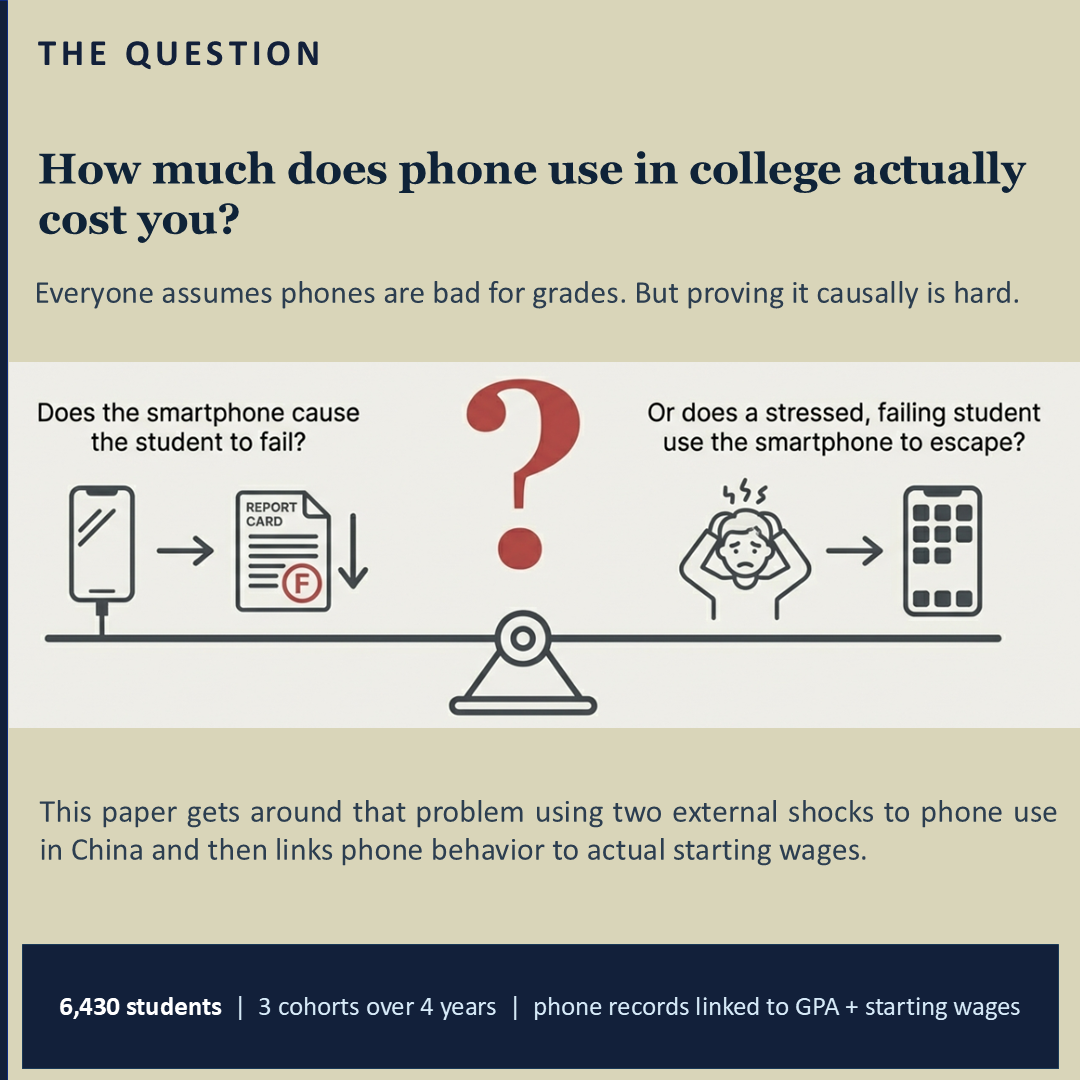
Economists Panle Jia Barwick, Siyu Chen, Chao Fu, and Teng Li tracked 6,430 students across three freshman classes at a Chinese university for four straight years. They linked actual phone records from a major carrier to GPA transcripts and, more crucially, to the starting wages recorded in official employment contracts students signed at graduation. That last piece is rare. Most research on phone use stops at grades. This one follows students all the way to the labor market.
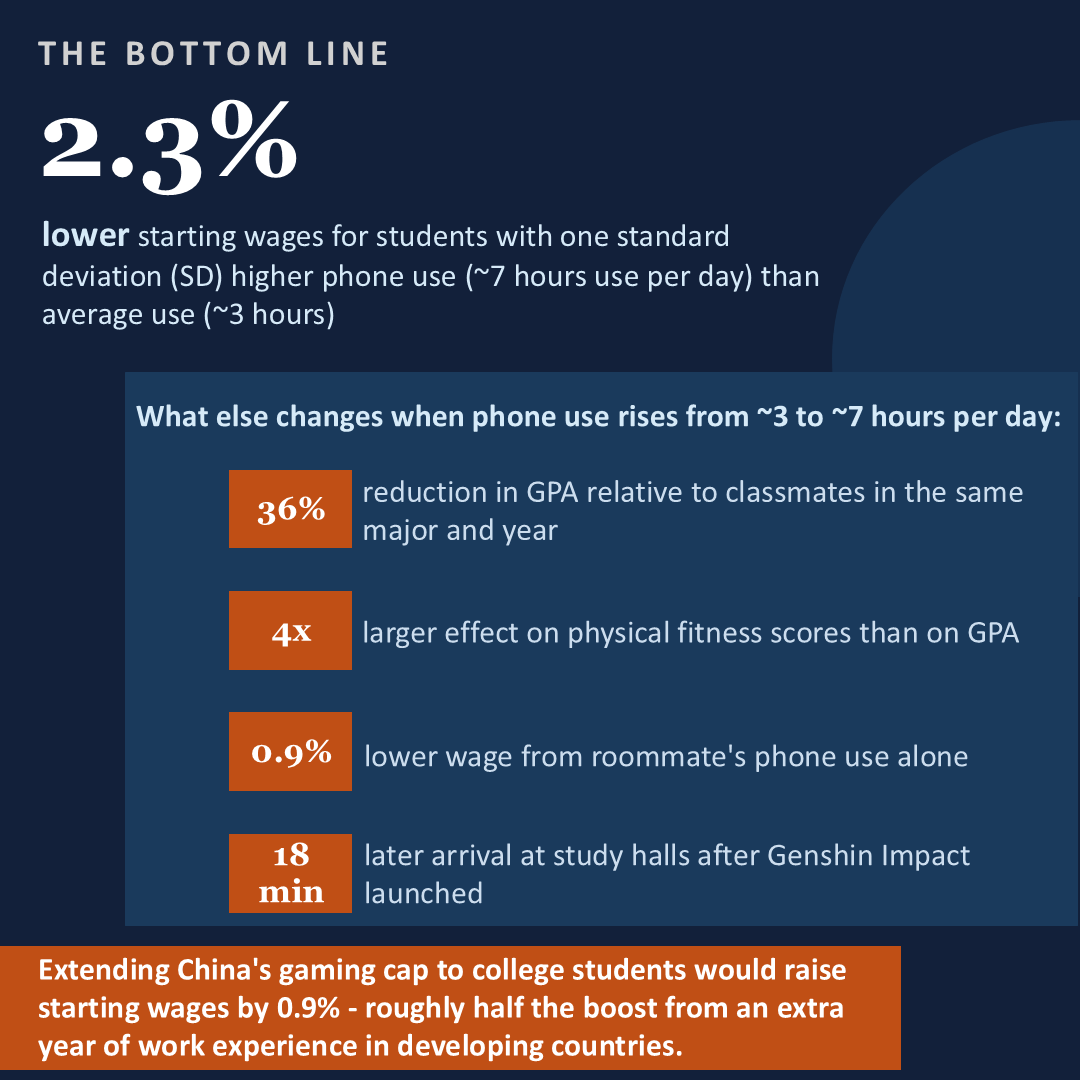
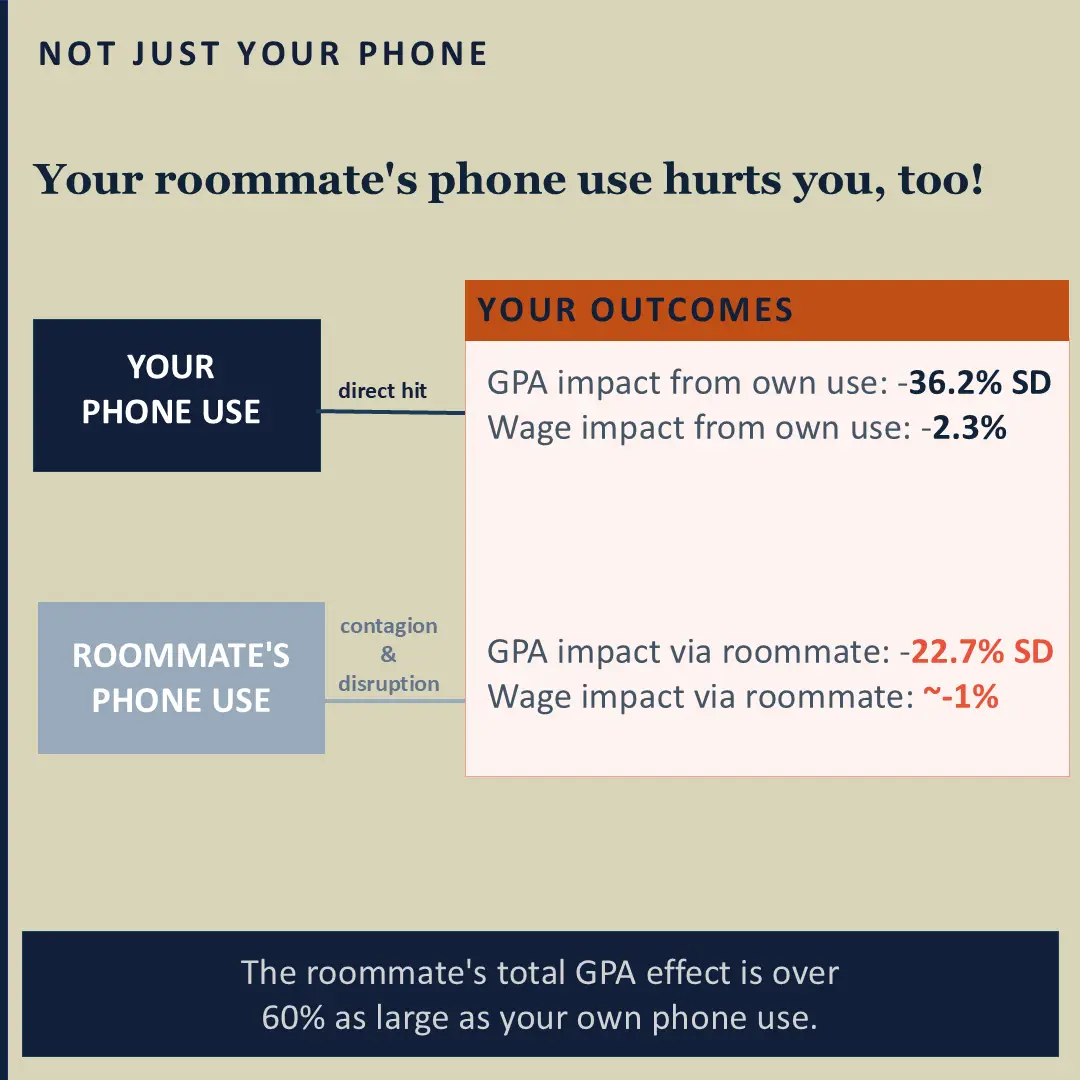
The surprise isn’t just that phone use hurt outcomes. It’s that your roommate’s phone habits matter almost as much as your own. Living with a heavy phone using roommate cuts your future pay by roughly 1% and reduces your GPA by an amount more than 60% as large as the hit from your own phone use.
That is the finding worth pausing on. Phone use in college is not a personal lifestyle choice with personal consequences. It spills over.
How the roommate effect works
The university in this study randomly assigned students to shared dorm rooms regardless of their backgrounds or habits. Because the assignment was random, any systematic relationship between a roommate’s phone use and your outcomes cannot be explained by similar people choosing to live together. The researchers could isolate causal effects directly from that random variation.
The roommate effect operates through two distinct channels.
The first is direct disruption. A roommate gaming or scrolling in a shared dorm room, where four to eight students live, sleep, and study within a few feet of each other, creates noise and distraction that impairs your ability to focus and sleep, regardless of what you are doing on your own phone.
The second is behavioral contagion. Phone use is genuinely infectious. When a roommate increases their usage significantly, it pulls your own usage up by roughly 5.8%. The researchers were careful to establish that this contagion is driven by what your roommate does around you (behavioral peer effects), not simply by the type of person they are (contextual peer effects). If phone use spreads primarily because of who your roommate is, there may not be very many policy tools to address the adverse effects of phone use. If it spreads because of what they do around you, changing the shared environment can actually work. According to this study, the behavioral channel dominates here. It is not who your roommate was before college that matters most — it is what they do in the room with you.
The finding that isn’t surprising
Heavy phone use in college hurts your grades and your starting salary. Most people believe this already, even if they can’t prove it. What the paper adds is rigorous causal proof and a precise magnitude.
Going from average phone use of roughly 3 hours a day to heavy use of roughly 6.7 hours a day is associated with about 2.3% reduction in starting wages. This heavy phone use also leads to a GPA drop that slides you from around the 50th percentile to roughly the 36th percentile within your own major and year. That is a meaningful shift in where you start on the wage ladder, with consequences that compound over a career.
When the authors simulate what would happen if China extended its existing gaming cap for minors to college students, they estimate starting wages would rise by 0.9%. That is roughly half the wage boost typically associated with an extra year of work experience in a developing economy. The peer multiplier amplifies this: restrict one person’s gaming, and their roommates benefit too.
What “phone use” actually means
When we talk about “phone use” in this study, we aren’t talking about using a calculator, checking your email, or looking up a map. For the average student using their phone about 3 hours a day, 73% of that time goes to three categories: social media, video, and games.
While we often tell ourselves our phones are “essential for school,” the data show that students spend an average of only 1.2 hours per month on educational apps, that’s less than 3 minutes a day!
The method, plain English
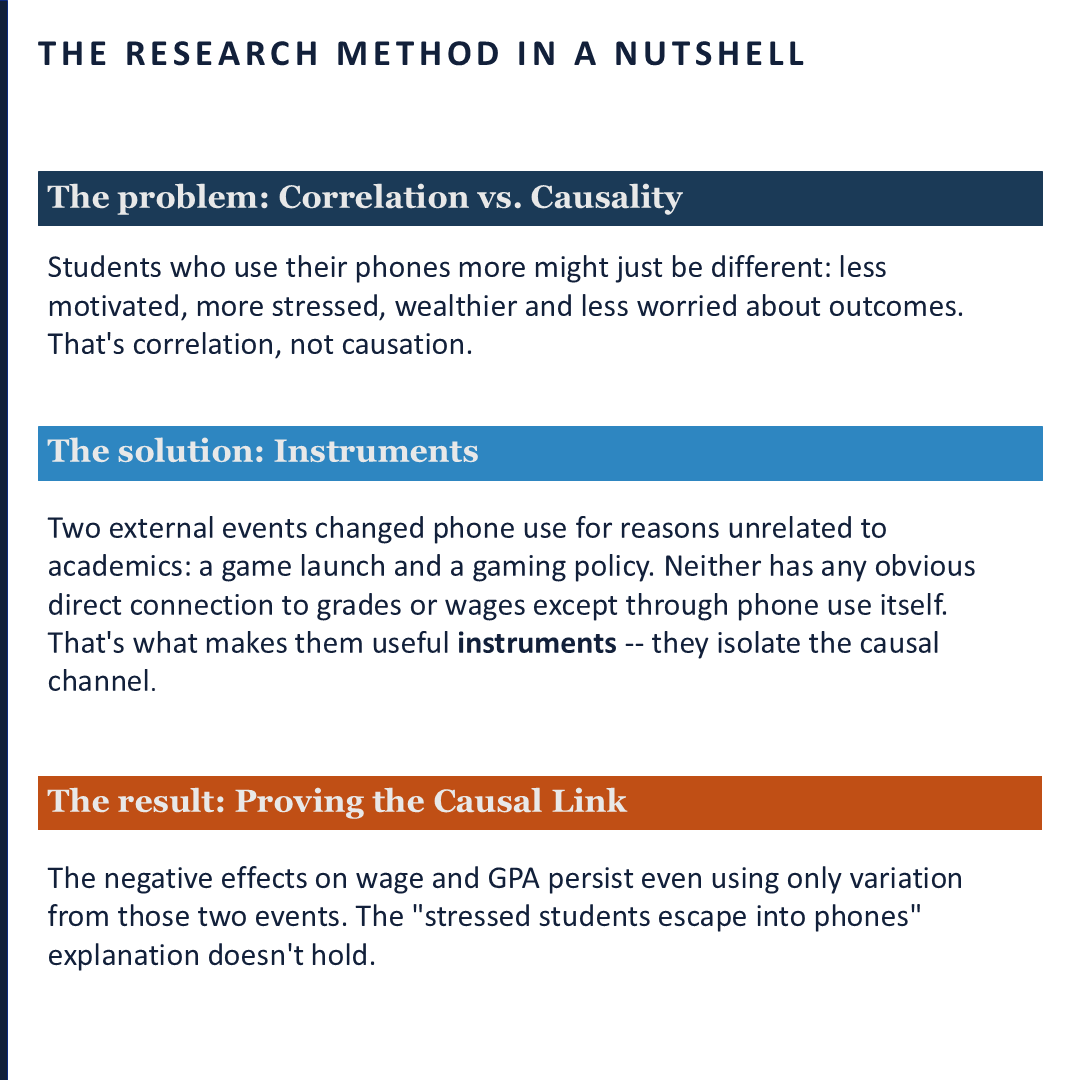
The main challenge in this kind of research is distinguishing causations from correlation. You cannot simply compare heavy and light phone users and call the difference a causal effect. Students who use their phones more might just be less motivated to begin with. Stressed students might escape into gaming.
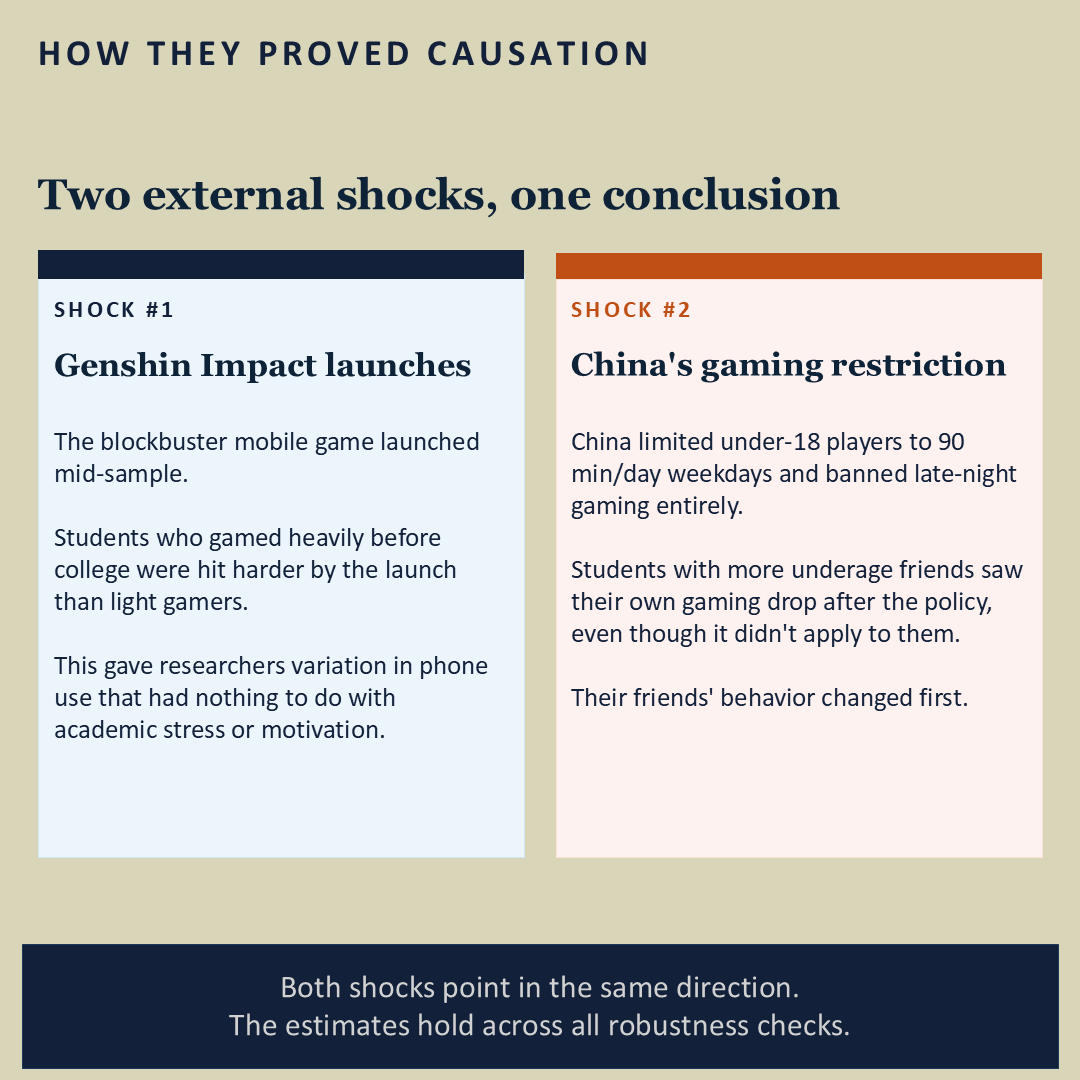
So, for this study, the researchers used two external events that changed phone use for reasons having nothing to do with any individual student’s motivation or academic situation. The first was the launch of Genshin Impact — a blockbuster mobile game — midway through the study period. Students who gamed heavily before college were hit harder by the launch than light gamers. That differential response, driven by an external entertainment event with no connection to the university’s academic environment, gave the researchers a source of variation in phone use they could trust.
The second was China’s 2019 gaming restriction policy for minors, which limited players under the age of 18 years to 90 minutes of gaming per day on weekdays and banned late-night gaming entirely. Students with more underage friends saw their own usage drop after the policy took effect, even though the policy applied directly to only 8% of students in the sample. It reached the rest indirectly through their underage social networks.
Both “shocks” created variation in phone use that was unrelated to academic stress, motivation, or ability. When researchers find consistent negative effects using only variation generated by a game launch and a government policy, neither of which has any obvious connection to academic stress or motivation, the ‘stressed students escape into phones’ explanation become difficult to sustain.
How it actually works
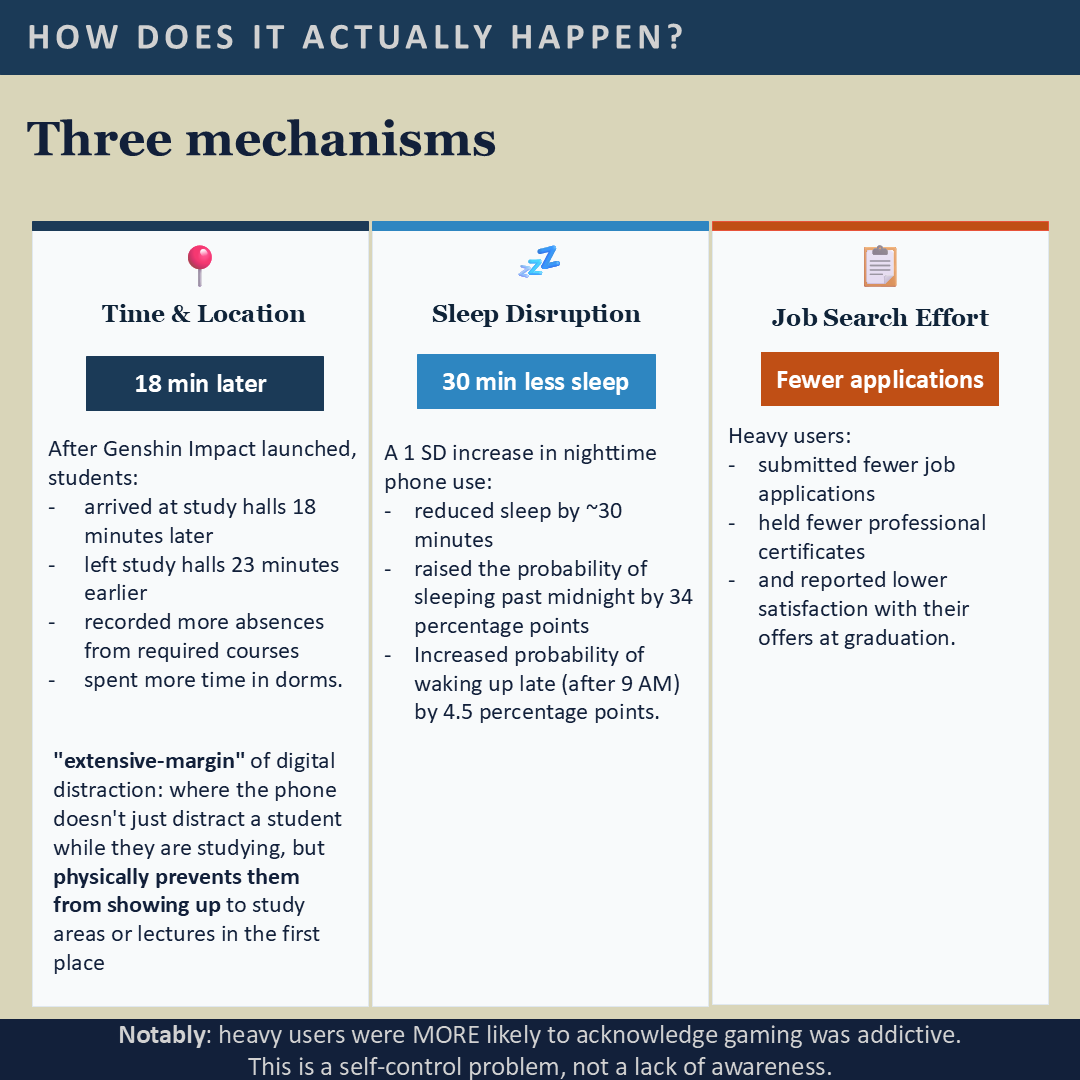
The GPS data in this study is very detailed and is recorded at five-minute intervals. After Genshin Impact launched, heavy users were observed arriving at study halls 18 minutes later and leaving 23 minutes earlier. They skipped more classes and spent more time in their dorms.
This is what economists call an extensive margin effect. The phone is not just distracting students while they study. It is preventing them from showing up to study in the first place. So, any policies targeting only classroom phone use may be addressing a fraction of a much larger behavioral pattern.
Nighttime phone use cut sleep by roughly 30 minutes and substantially increased the probability of sleeping past midnight. Survey data showed heavy users submitted fewer job applications before graduation, held fewer professional certifications, and reported being less satisfied with the offers they received. Restricting phones in classrooms would not touch any of it. Note that these patterns are associational rather than causal, but they are consistent with the paper’s broader findings.
There is another result worth highlighting separately. The effect of phone use on physical education scores, i.e., scores in a required course involving outdoor physical activity, is nearly four times as large as the effect on academic GPA. A roommate’s gaming, however, shows no statistically detectable effect on PE scores, suggesting the peer disruption effect is concentrated in shared indoor study environments rather than outdoor physical activity, where the direct noise and distraction channel is less relevant.
They knew. It didn’t help.
In the paper’s survey, heavy users were more likely than light users to acknowledge that gaming was addictive. The problem is not that students lack information about their phone habits. However, knowing something is a bad idea and actually stopping are two different skills. This is a self-control problem. The implication for policy is that awareness campaigns are probably the wrong tool. Students are already aware. What they need is a change in their environment, a commitment device that removes the choice in moments when willpower is scarce. Gaming restrictions function exactly this way.
A note on context
This study takes place at a mid-tier Chinese university where four to eight students share a single dorm room and most studying happens in shared spaces. The peer effects are large in part because the physical environment makes them large: when your roommate’s gaming is happening three feet from your desk, the disruption is immediate. American campuses with single or double occupancy rooms, larger libraries, and more private study options would likely produce smaller peer effect estimates, though the direction of the findings would almost certainly hold.
So, what?
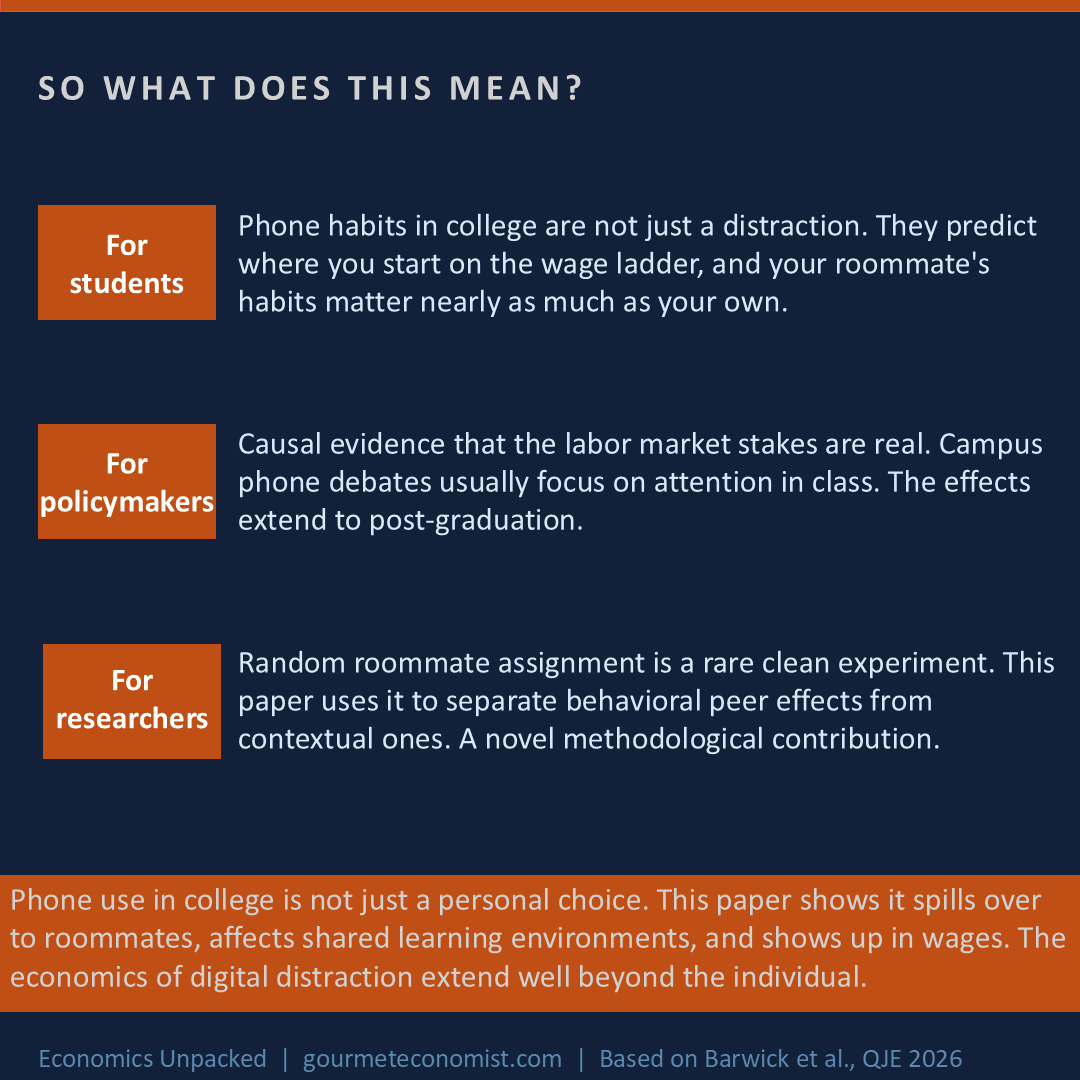
For students, the paper makes something concrete: phone habits in college are not just a distraction during class. They predict where you start on the wage ladder four years later. And your roommate’s habits matter almost as much as your own, which is not something most people factor into how they think about their living environment, their study choices, or their time.
For anyone who thinks about campus policy: administrators, faculty, student affairs professionals, the paper offers something more useful than the usual classroom attention argument. The effects extend to the extensive margin: students who game heavily are not just distracted while studying, they are less likely to show up to study areas at all. Policies that only target classroom phone-use may be addressing a small part of a larger behavioral pattern.
For researchers, the methodological contribution here is the separation of behavioral from contextual peer effects using a combination of random assignment and quasi-experimental variation from an external policy shock. It is a clean design that other researchers can learn from and build on.
The broader point is simple. Phone use in college is not a private decision with private consequences. It affects shared learning environments, shapes labor market trajectories, and spills over to the people sleeping three feet away. The economics of digital distraction extend well beyond the individual, and this paper is the most rigorous evidence yet of exactly how far.