
Based on: Taha Choukhmane, Lucas Goodman, Cormac O’Dea, Efficiency in Household Decision-Making: Evidence from the Retirement Savings of US Couples, The American Economic Review, Volume 115, Issue 5, May 2025, Pages 1485-1519, https://doi.org/10.1257/aer.20230524.
The short version: Nearly one in five married couples in a large study left employer retirement matching contributions unclaimed, even though collecting them would not have required saving an additional dollar. Researchers linked the rules of more than 6,000 employer retirement plans to IRS records. In their baseline sample, 19.3% of couples could have collected more employer match by moving existing savings between spouses’ accounts. Among those couples, the average forgone match was $757 a year. A simulation estimates an average retirement wealth shortfall of about $13,800 at age 65 across all simulated couples, including those who did not miss any employer match.
Was it a mistake or a choice? A companion survey found both. Some respondents had not noticed the opportunity. Others kept allocations that missed employer money, citing independence, fairness, and risk.
The research, in slides (swipe or click through)
How the match math works
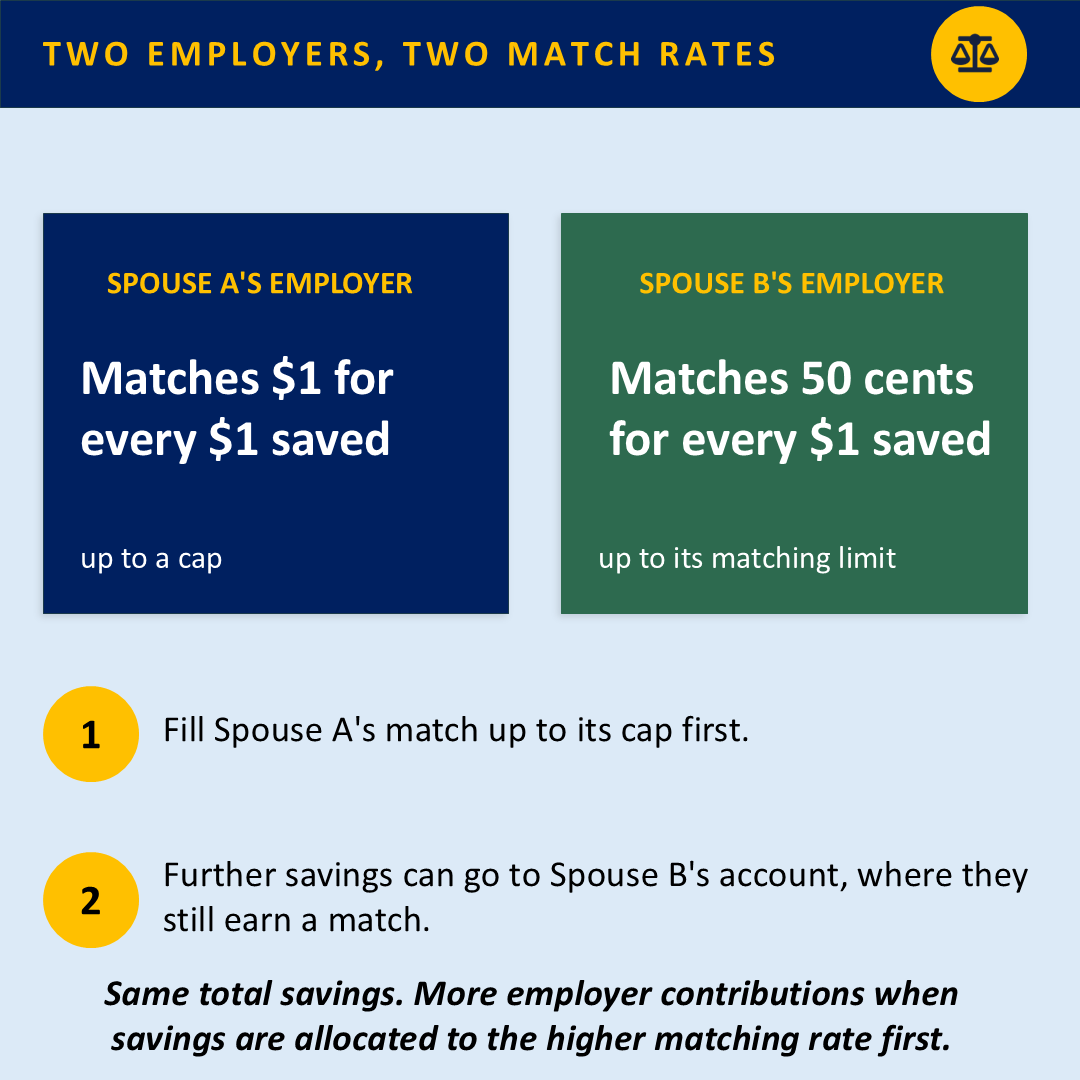
Suppose a hypothetical couple has $4,000 to save for retirement. Spouse A’s employer matches every dollar of employee contributions, up to $3,000. Spouse B’s employer matches 50 cents for every dollar contributed, also up to $3,000.
If the couple splits the money evenly, each spouse contributes $2,000. Spouse A’s employer adds $2,000, and Spouse B’s adds $1,000, for $3,000 in total employer contributions.
If the couple instead directs savings to the more generous match first, Spouse A contributes $3,000 and Spouse B the remaining $1,000. Spouse A’s employer adds $3,000, and Spouse B’s adds $500, for $3,500 in total employer contributions.
Allocation | Spouse A saves | Spouse B saves | Employer adds (A + B) |
Even split | $2,000 | $2,000 | $2,000 + $1,000 = $3,000 |
Match-first | $3,000 | $1,000 | $3,000 + $500 = $3,500 |
The couple saves the same $4,000 either way, but the second allocation earns an additional $500 in employer contributions. That $500 is the forgone match under the even split.
The authors call the gap between the maximum employer match a couple could have earned for a fixed amount of total household savings and what it received the forgone match. They classify a couple with a positive forgone match as noncoordinating. A couple with no forgone match, however, may have reached that outcome without coordinating, for example, if each spouse fully used their own employer’s match.
Why economists care about household efficiency
Most economic models of the household, whether they treat a couple as one decision maker or as two people bargaining, share an assumption: no mutually beneficial reallocation of resources remains available within a given period. This is a form of Pareto efficiency. In practical terms, the question is whether a couple could rearrange its resources to make at least one spouse better off without making the other worse off. Earlier studies mostly tested the assumption using survey data on household consumption, and most failed to reject it. The authors cite one study suggesting that consumption tests in small samples may lack the statistical power to detect inefficiency. Studies of household investment in developing countries and field experiments have produced more mixed results, leaving open the question of whether those findings extend to high-stakes financial decisions in naturally occurring settings.
The authors argue that workplace retirement matching offers a clearer test. The incentives are large and easy to measure, and the rate of return follows a formula that is relatively simple for individuals to understand. They also argue that the setting is favorable to cooperation for three reasons. Couples in the sample earn approximately twice as much as the average U.S. household, so they are presumably more educated and financially literate. Retirement saving is a repeated decision, so couples have time to learn. And retirement savings accumulated during marriage are generally treated as marital property in divorce. Absent a prenuptial agreement, how they are divided is not influenced by which spouse made the contributions, although division rules may vary by jurisdiction and circumstances. The authors argue that this creates an incentive to maximize joint retirement wealth, even for couples who anticipate divorce. So, it is even more notable when couples still leave match money unclaimed under these conditions.
The method, plain English
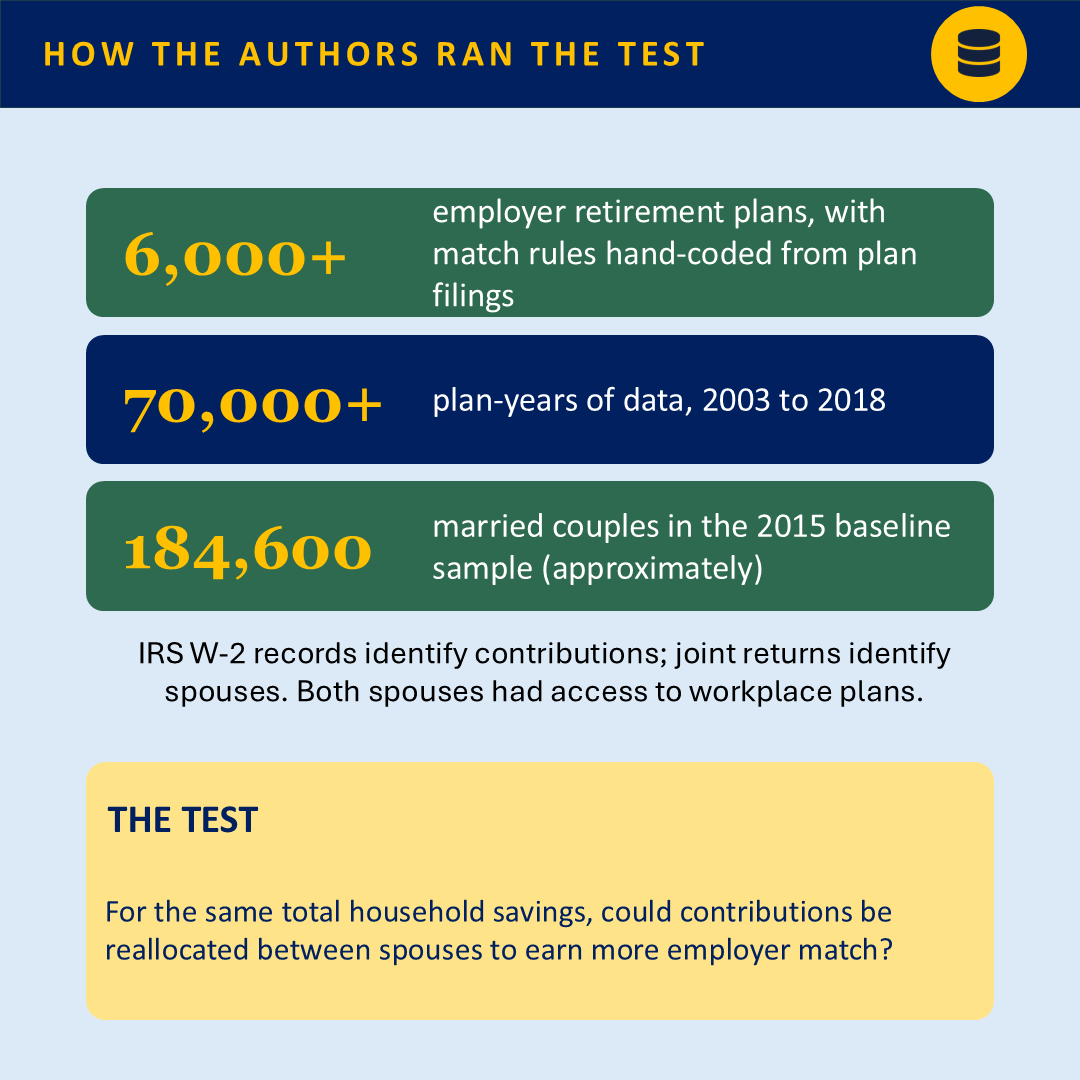
The authors hand-coded match rules, vesting rules, and automatic-enrollment features from plan filings covering more than 6,000 plans and over 70,000 plan-years (2003 to 2018), then linked them to IRS data: W-2 forms show each worker’s contributions, and joint tax returns identify spouses.
The study focuses on married couples filing jointly in which both spouses earn positive wages, work at firms with defined contribution plans, and are at least 21 years old. That is roughly one-third of married U.S. tax filers. The test applies to couples in which at least one spouse contributes and at least one employer offers a match. In their main 2015 baseline sample of about 184,600 couples, the authors excluded cases that could distort the comparison, such as a spouse who is not yet fully vested, job tenure of one year or less, or large age gaps that affect when each spouse can withdraw funds without penalty. The authors note that these sample restrictions make little difference to the headline result.
A couple can have no foregone match by luck, so the authors also estimate how often couples would miss the match if they never planned together. They use two sets of comparison couples, built from people matched on gender, age, and earnings, and a third benchmark: the same people’s choices when unmarried, four years before marriage or four years after divorce.
They also surveyed about 1,000 married, working Americans aged 18 to 59 who had a retirement plan through Prolific. Each split a hypothetical savings amount between their own and their spouse’s accounts, with different matching schedules. If the split missed the match, they were told and asked whether it was intentional. Those who said no could choose again. Respondents who corrected the missed match were classified as accidental. Those who intentionally retained their allocation or did not eliminate the missed match after being informed were classified as deliberate.
What the data show
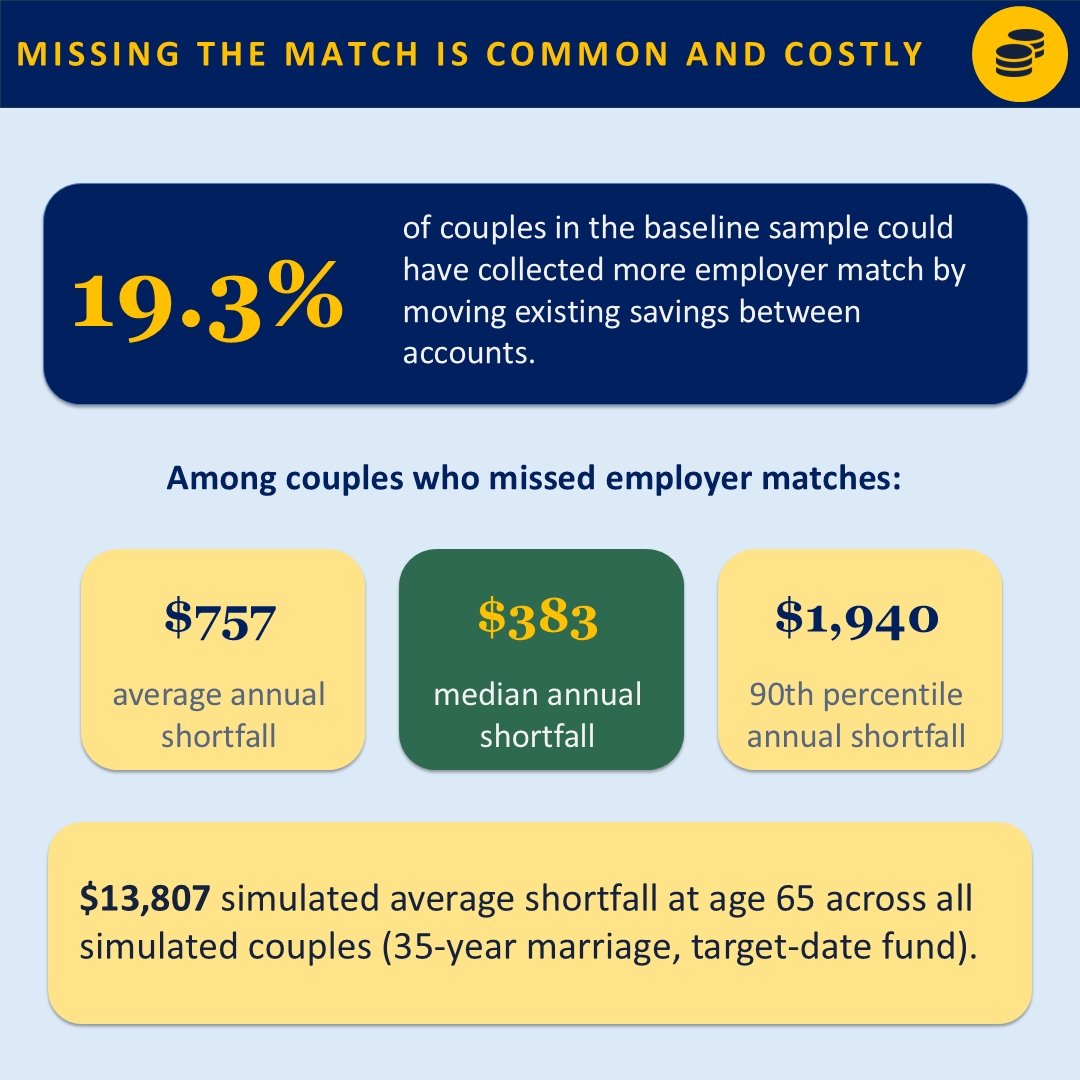
Missing the match is common and costly. In the baseline sample, 19.3% of couples had forgone match. Among them, the average was $757 a year, the median $383, and the ninetieth percentile $1,940. A simulation assuming a 35-year marriage and a target-date fund puts the average shortfall at age 65 at $13,807 across simulated couples, including those who never miss a match. It illustrates potential costs and is not an observed loss.
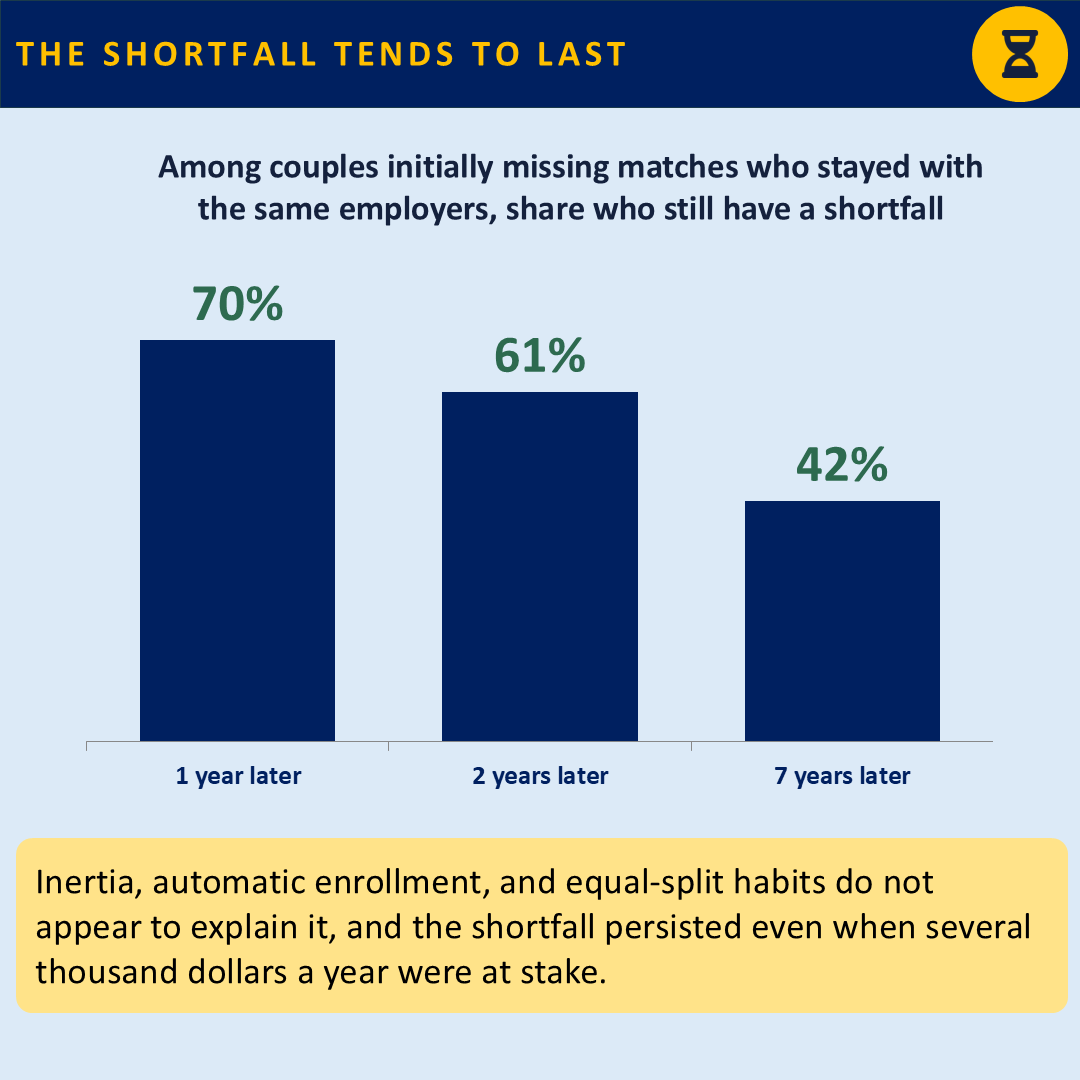
It persists. Among couples who stayed with the same employers, 70% still had forgone match a year later and 42% seven years later. Inertia, automatic enrollment, and equal-split habits did not appear to explain it. Active changes did not systematically shrink forgone match, and it persisted even when several thousand dollars a year were at stake.
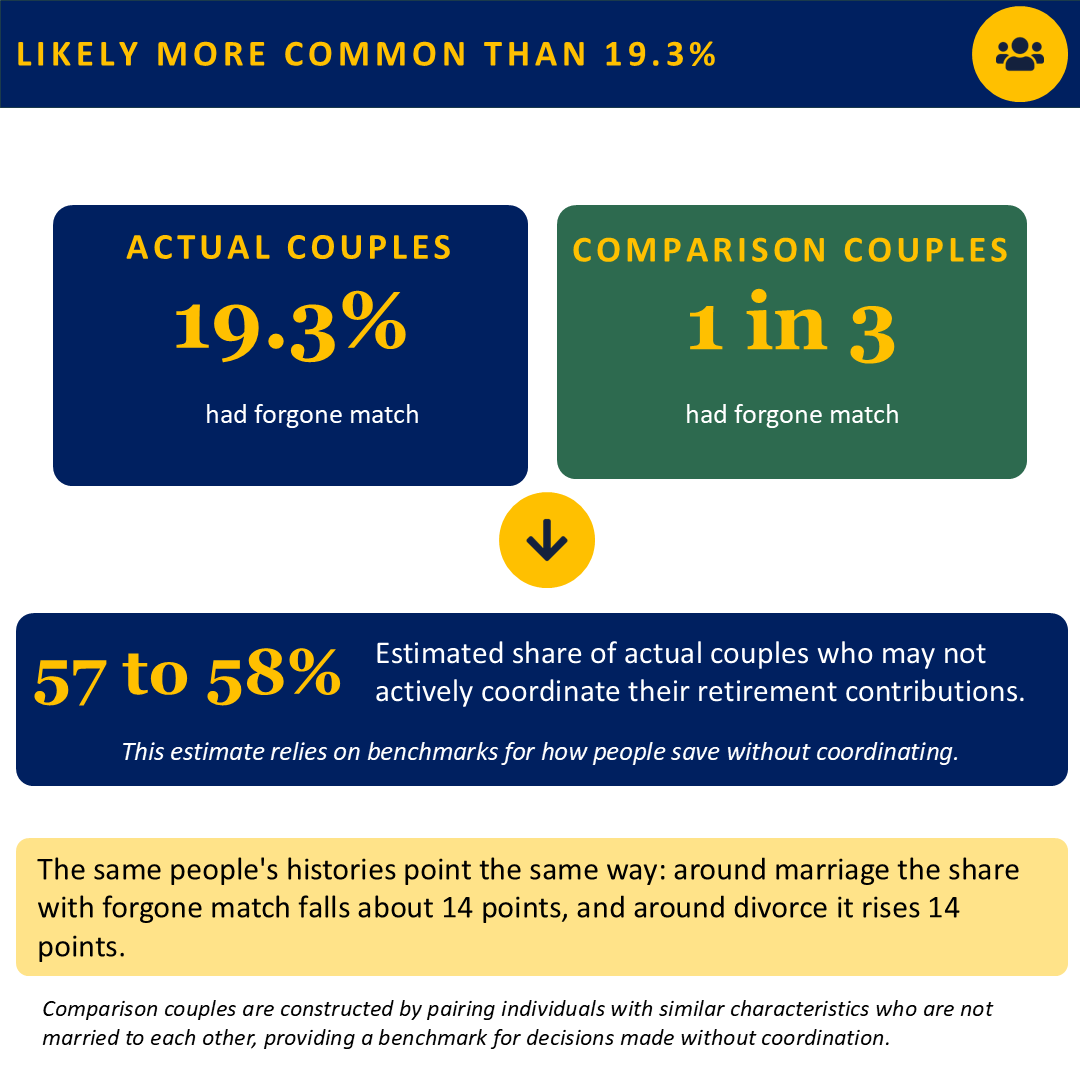
Likely more common than 19.3%. The observed 19.3% may understate how common noncoordination is, because some couples can maximize their matches without actively planning together. About one in three comparison couples had forgone match. Using comparisons with artificially constructed couples and individuals’ savings decisions outside marriage, the authors estimate that roughly 57% to 58% of couples like those in the sample may not actively coordinate their retirement contributions. This estimate depends on the validity of those benchmarks. In the nine years around marriage, the share with forgone match falls about 14 percentage points. Around divorce, it rises 14 points.
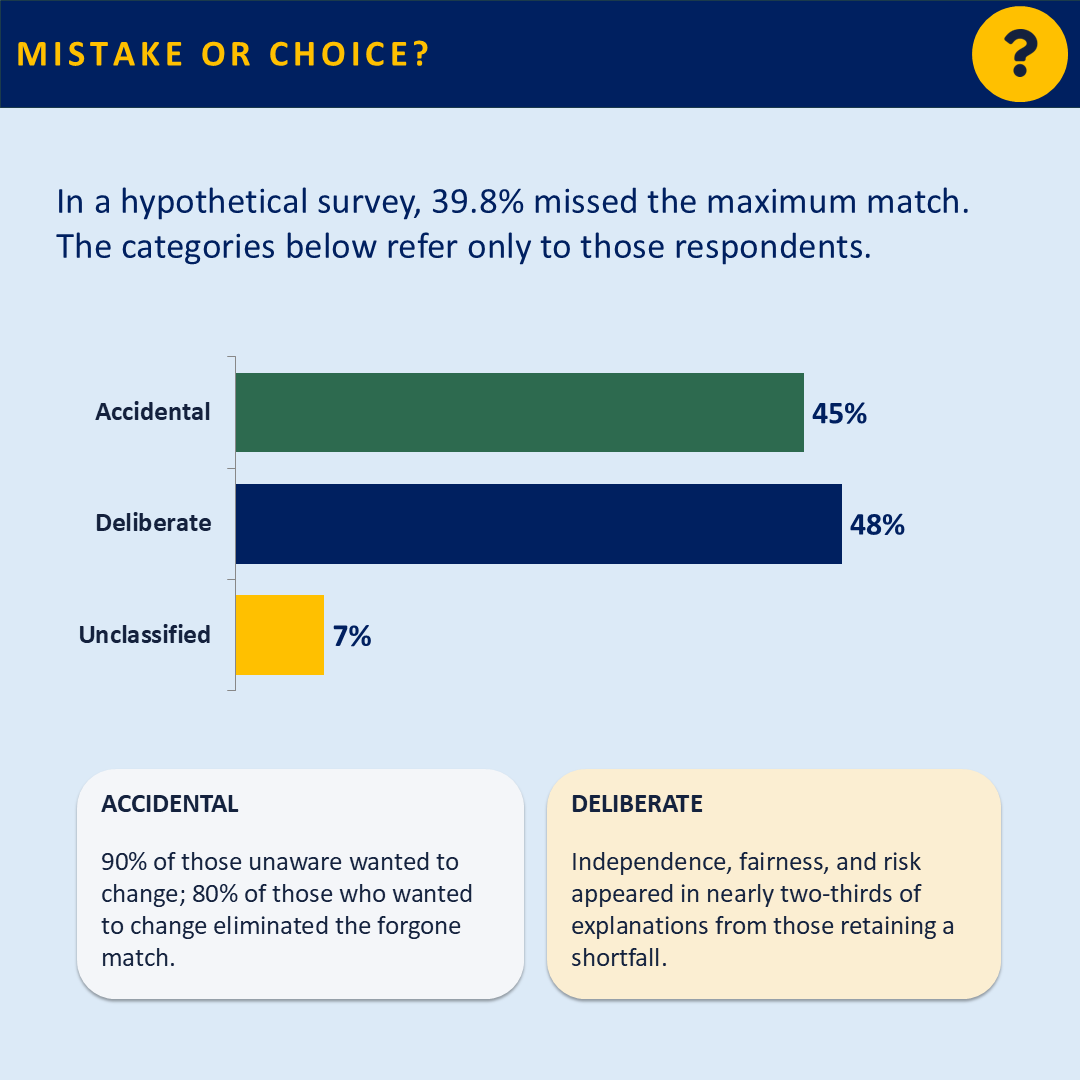
Some are mistakes. In the survey, 39.8% of respondents did not maximize the match. That is not comparable to 19.3% because only one split is efficient in the survey, and each respondent chooses for both spouses. Of those with forgone match, 45% were accidental and 48% deliberate. Among respondents who had not noticed the shortfall, 90% wanted to change once told. Of those who wanted to change, 80% successfully eliminated the forgone match. The share of respondents with forgone match fell from 64.0% among those who answered two or fewer of five financial literacy questions correctly to 25.3% among those who answered all five, though the authors note that this may partly reflect engagement with the survey.
Others are choices. Respondents who kept their allocations most often cited independence, fairness, and risk, themes in close to two-thirds of explanations. In the administrative tax data, after accounting for other characteristics, couples with a mortgage were 2.4 percentage points less likely to have forgone a match, and couples with a joint bank account before marriage were 1.5 percentage points less likely. These are noisy proxies for commitment, not causal evidence. In the survey, over a third of respondents incorrectly believed they would keep their own retirement savings upon divorce. Among this group, 27.8% deliberately missed out on employer match money, compared to just 15.3% of those who understood that retirement assets get divided. Wives were also more likely than husbands to be the oversaver, the spouse whose contributions would need to move to the other’s account, across earnings levels. That is consistent with preferences for control or beliefs about divorce, but not proof of either.
Where this evidence is strong, and where it is suggestive
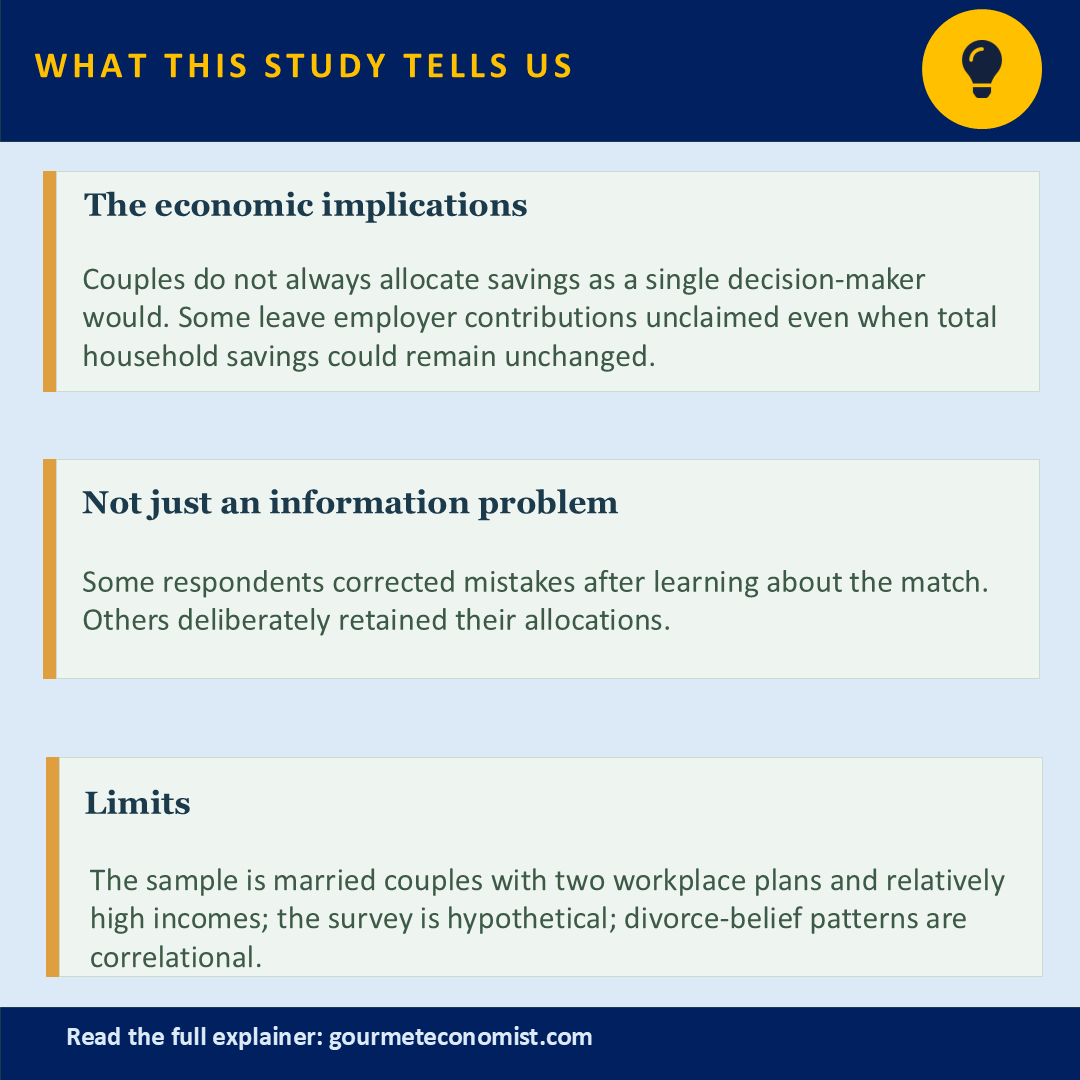
The administrative tax data provide the strongest evidence. The authors examine actual contributions and each spouse’s matching rules, and their checks suggest that coding errors in the hand-built plan data do not account for the findings. The sample, however, consists of married couples with two workplace plans and relatively high incomes, so the results should not automatically be generalized to other households. The estimated 57% to 58% of couples who do not actively coordinate their retirement contributions is inferred from benchmarks for noncoordination, rather than directly observed. The tax data cannot establish whether spouses discussed their savings decisions. The survey uses hypothetical choices, while the tax data evidence on marital commitment and the survey evidence on divorce beliefs are suggestive rather than causal.
The efficiency test focuses on forgone employer-matching contributions, not on every dimension of household welfare. Someone who values keeping retirement savings in their own account may be valuing something the matching formula does not measure. The authors nevertheless treat the unclaimed match as surplus that both spouses could have shared, which is why they classify the allocation as inefficient.
So, what?
The immediate finding is that employer matching schedules differ, and in this large study, about one in five couples with two workplace retirement plans could have collected more employer contributions by reallocating existing savings between their accounts. The survey also shows that some respondents had not considered this opportunity, while others weighed financial independence, fairness, and risk in ways the matching formula does not capture.
The findings also have implications for how financial information is communicated. Many respondents who learned about a missed match wanted to correct their allocations, suggesting that part of the problem is informational. But the paper does not advocate a particular policy response, and deliberate choices suggest that information alone may not resolve concerns about control and financial security.
For economic research, the contribution lies in both the test and the data. The paper provides a measurable test of household efficiency using actual financial decisions in a high-stakes setting. Earlier evidence, particularly from investment decisions in developing countries and experimental settings, has been mixed. The authors interpret their findings as supporting a greater role for models that allow inefficient household outcomes, which they note are less commonly used in applied research.
The broader point is that a household is not a single decision maker. Two people with separate accounts, separate employers, and potentially different expectations about the future of their marriage can leave financial gains unrealized that a single decision maker could capture.