
Based on: Natalia Emanuel, Emma Harrington, Amanda Pallais, The Power of Proximity to Coworkers, The Quarterly Journal of Economics, Volume 141, Issue 3, August 2026, Pages 1825–1870, https://doi.org/10.1093/qje/qjag027.
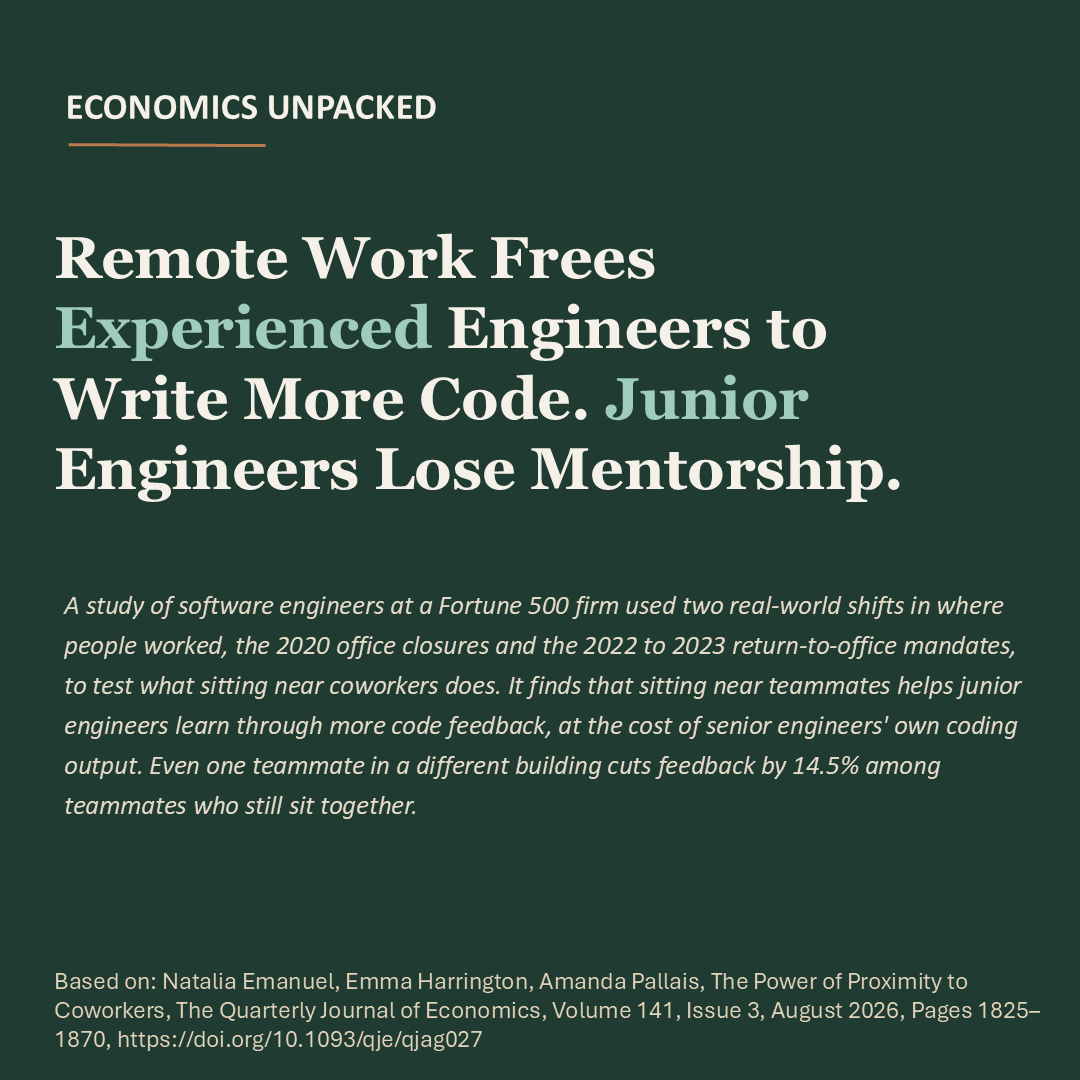
The short version: Economists analyzed five years of data from software engineers at a Fortune 500 online retailer. They found that sitting near teammates increases code review feedback and improves code quality, especially for junior and younger engineers, but takes time away from senior staff, who write less code as a result. Even one teammate in another building shifts meetings online, cutting feedback among co-located colleagues by 14.5%. When offices closed, the firm shifted toward hiring older, more experienced engineers, consistent with buying skills, which they could no longer easily mentor in-house. A back-of-the-envelope calculation suggests that remote work could account for 64% of the total rise in unemployment among young college graduates during the period studied.
The research, in slides (swipe or click through)
Winners and losers of office closures and return-to-office mandates
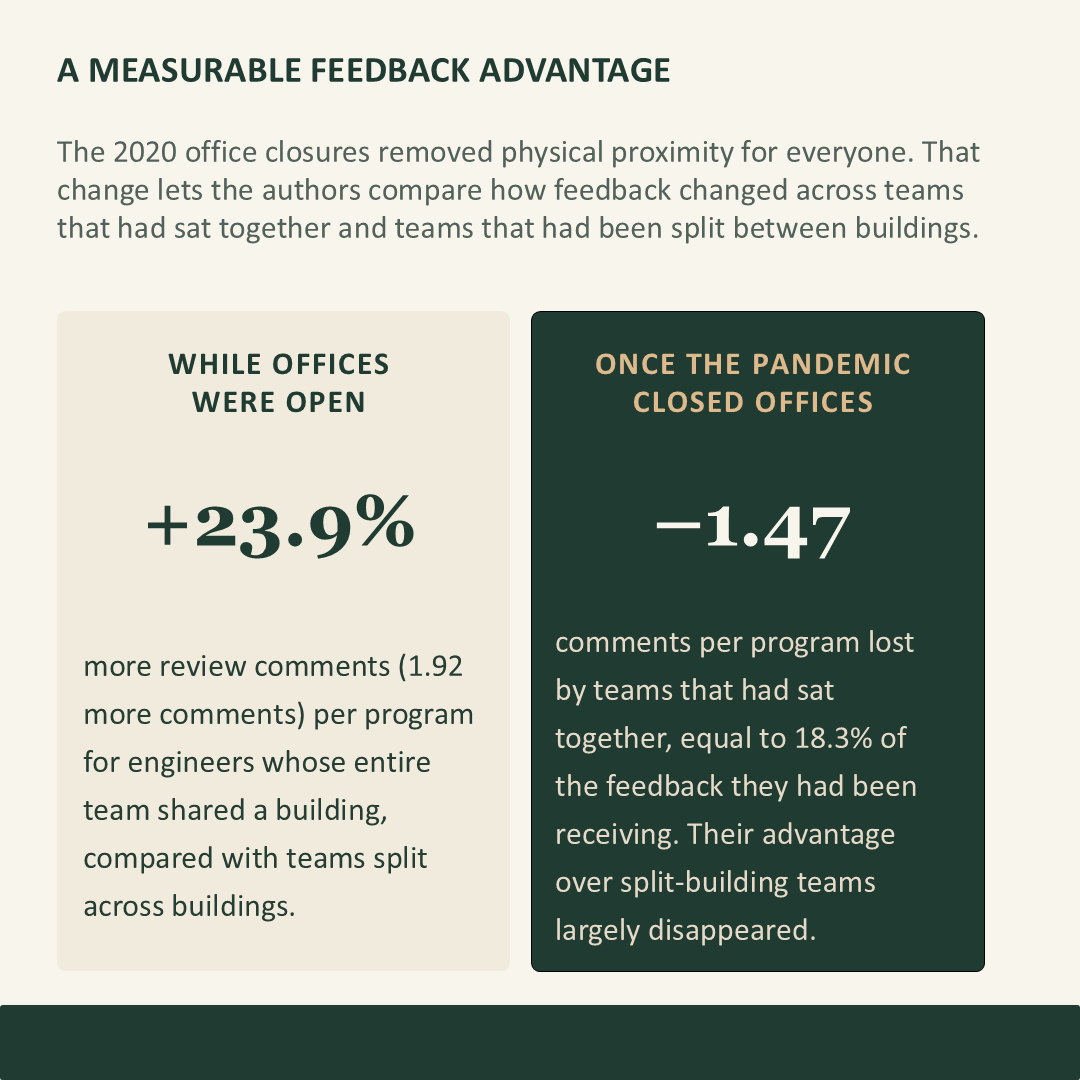
In this study, economists tracked software engineers at a Fortune 500 online retailer from 2019 to 2024, evaluating how physical proximity shaped mentorship, code quality, and productivity amid the 2020 office closures and subsequent return-to-office mandates. While offices were open, engineers sitting near their teammates received 23.9% more code feedback than colleagues on multi-building teams, about 1.92 more comments per program. When the pandemic closed the offices, that advantage largely disappeared. Teams that had sat together lost 1.47 comments per program relative to teams split across buildings, equal to 18.3% of the feedback they had been receiving, and the gap between the two groups shrank to 7.1%.
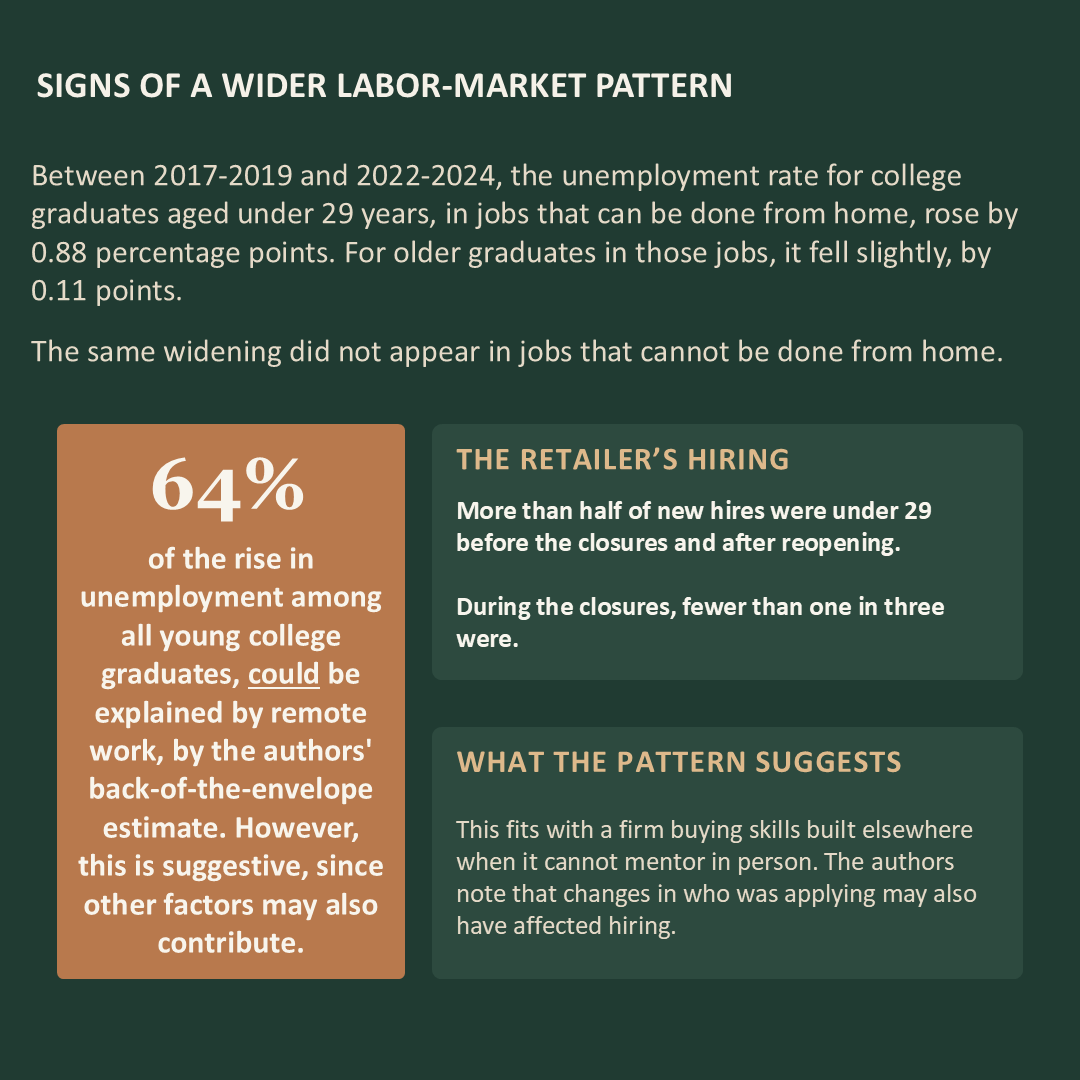
This feedback gap may matter beyond one firm. Sitting together accelerates skill development among junior workers, and the paper connects this lack of mentorship to broader trends in the national economy. Using national survey data, the authors find that between 2017 and 2019 and between 2022 and 2024, unemployment rose more for young college graduates in jobs that can be done remotely than for older graduates in those jobs, or for young graduates in jobs that cannot be done remotely. Their back-of-the-envelope estimate is that remote work accounts for 64% of the total rise in unemployment among young college graduates. The authors urge caution with this national estimate.
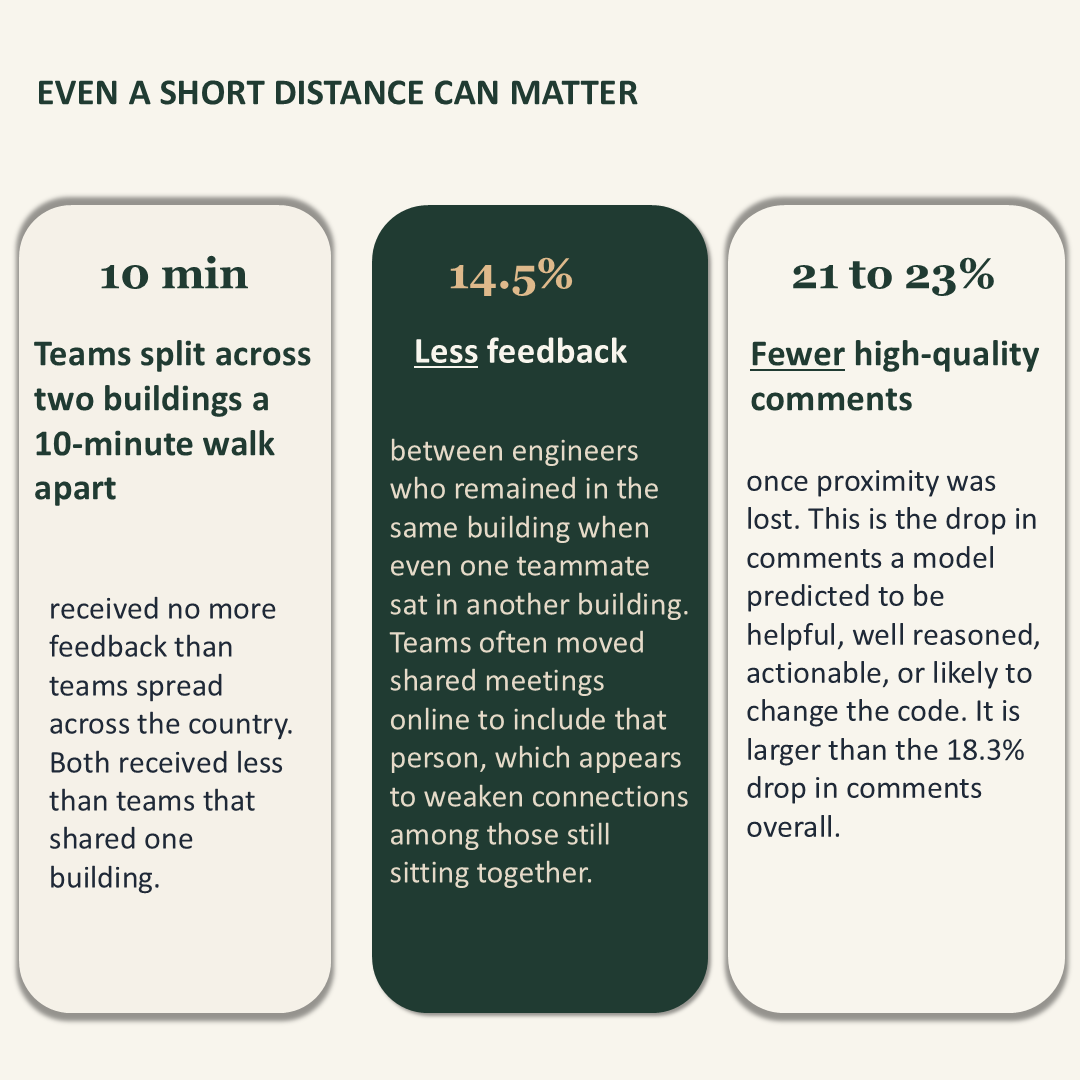
However, physical proximity has a cost, too. Mentorship takes time away from senior staff, who write significantly less code when sitting near their teammates. Furthermore, team proximity is fragile. Under common workplace norms, having even a single teammate in another building shifts daily meetings online and reduces code feedback among co-located colleagues by 14.5%. Firms face a trade-off between immediate senior output and long-run junior training, which led the retailer studied to shift toward hiring older, more experienced engineers when offices were closed. Before the closures and again after offices reopened, well over half of the firm’s new hires were under 29; during the closures, that share fell to less than a third.
How sitting together turns into skills
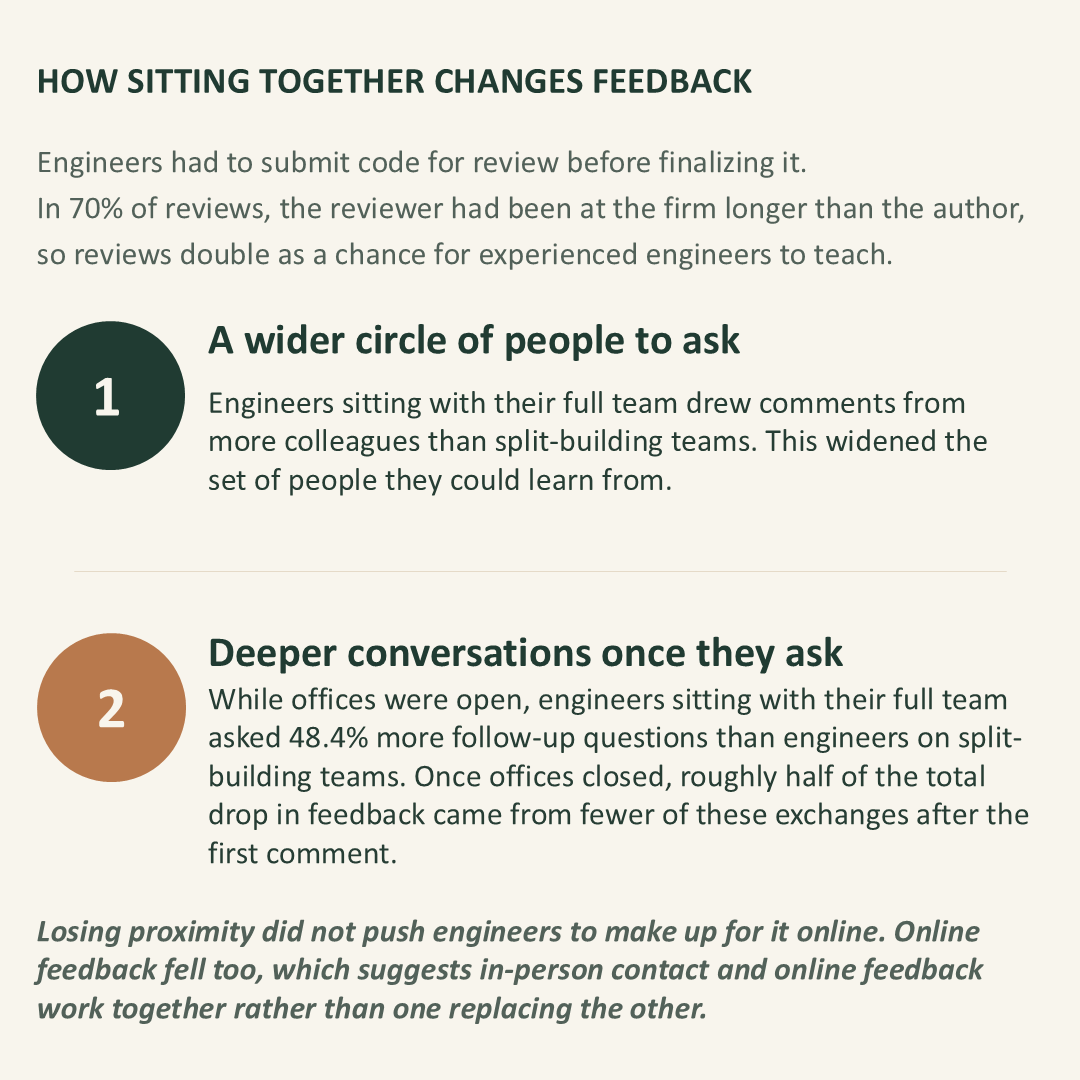
Software engineers at the firm cannot finalize code without a prior code review. In the review, a colleague inspects proposed changes, flags issues, and suggests improvements, a workflow that serves as a key channel for mentorship. The reviewer has more firm tenure than the person whose code is being reviewed in 70% of reviews.
Physical proximity influences this process in two ways. First, co-located engineers draw feedback from a broader network of peers rather than repeatedly consulting the same individuals. Second, conversations run deeper: co-located engineers ask 48.4% more follow-up questions, and roughly half of proximity’s total feedback effect occurs through these back-and-forth exchanges rather than the initial review comment alone. When physical proximity is removed, digital feedback drops as well, showing that in-person interaction complements digital tools rather than substitutes for them.
The finding that isn’t surprising
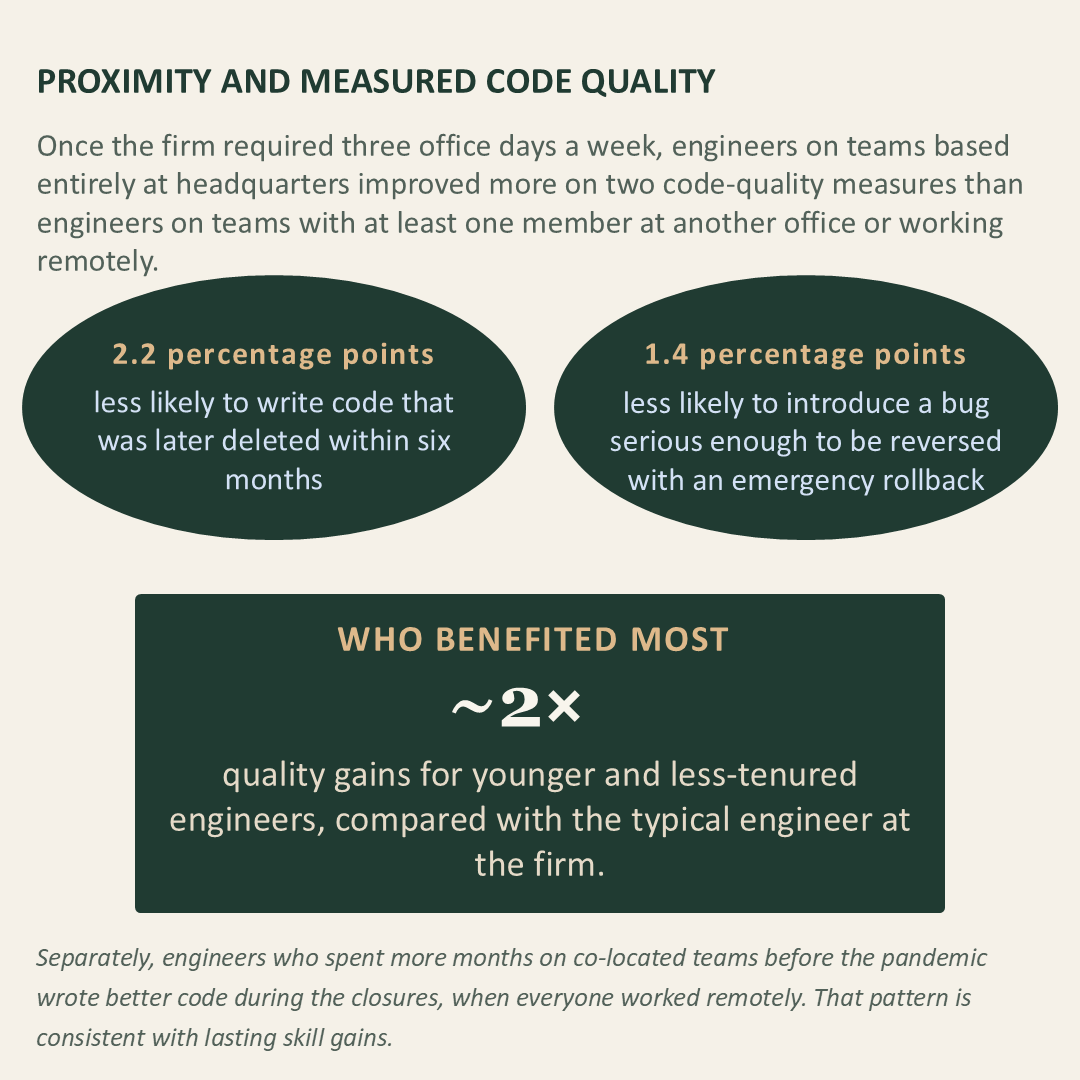
Using the return-to-office mandates as a second natural experiment, the authors track two distinct measures of code quality: churn, defined as adding files that are deleted within six months, and bugs, defined as code errors severe enough to require an emergency rollback. Once the firm required three office days a week, a gap opened up in code quality: co-located engineers were 2.2 percentage points less likely than geographically distributed engineers to write code that was later scrapped, and 1.4 percentage points less likely to introduce a bug serious enough to trigger an emergency rollback. Junior and younger engineers benefited about twice as much as the typical engineer in the sample.
Separately, the paper finds that this benefit outlasts the mentoring relationship itself. Engineers who had spent more time on co-located teams before the pandemic continued to write higher-quality code during the fully remote period. This is consistent with the idea that proximity builds durable human capital rather than merely providing temporary oversight.
Some definitions, because precision matters
“Teammates” means everyone reporting to the same manager. “Co-located” means every one of those teammates was assigned to the same building. “Multi-building” means the team was split between the firm’s two headquarters buildings, which are roughly a 10-minute walk apart. “Geographically distributed” means at least one teammate worked remotely or from a satellite office, sometimes more than 100 miles away.
“Feedback” refers specifically to comments exchanged during code review on GitHub, the platform engineers used to submit and revise their work. Before offices closed, engineers received an average of 6.5 comments per program, with each comment running about 16 words. These are not perfunctory notes. They typically explain the underlying reasoning behind a suggested change, which is why losing them hinders long-term skill development, not just code quality in the moment.
The method, plain English
We cannot simply compare engineers who happen to sit in the same building to those who do not and call the difference the causal effect of proximity. People and teams sort themselves. A manager who values face-to-face collaboration might staff a co-located team differently than one who does not. Those underlying differences, not proximity itself, could drive the gap in feedback.
The authors resolve this issue with two quasi-experimental shocks to physical proximity. Each shock pairs a different comparison group with a different outcome. The first uses the 2020 pandemic office closures. These instantly erased the distinction between co-located and multi-building teams, since everyone went fully remote at once. Feedback data is only available through the closures, so this design tracks how the feedback gap between co-located and multi-building teams changed once offices shut down.
The second uses the firm’s 2022 and 2023 return-to-office mandates. These brought co-located teams back together while geographically distributed teams remained apart. Code quality data is only available from the closures onward, so this design instead tracks how code quality and output differed between co-located and geographically distributed teams as offices reopened in stages.
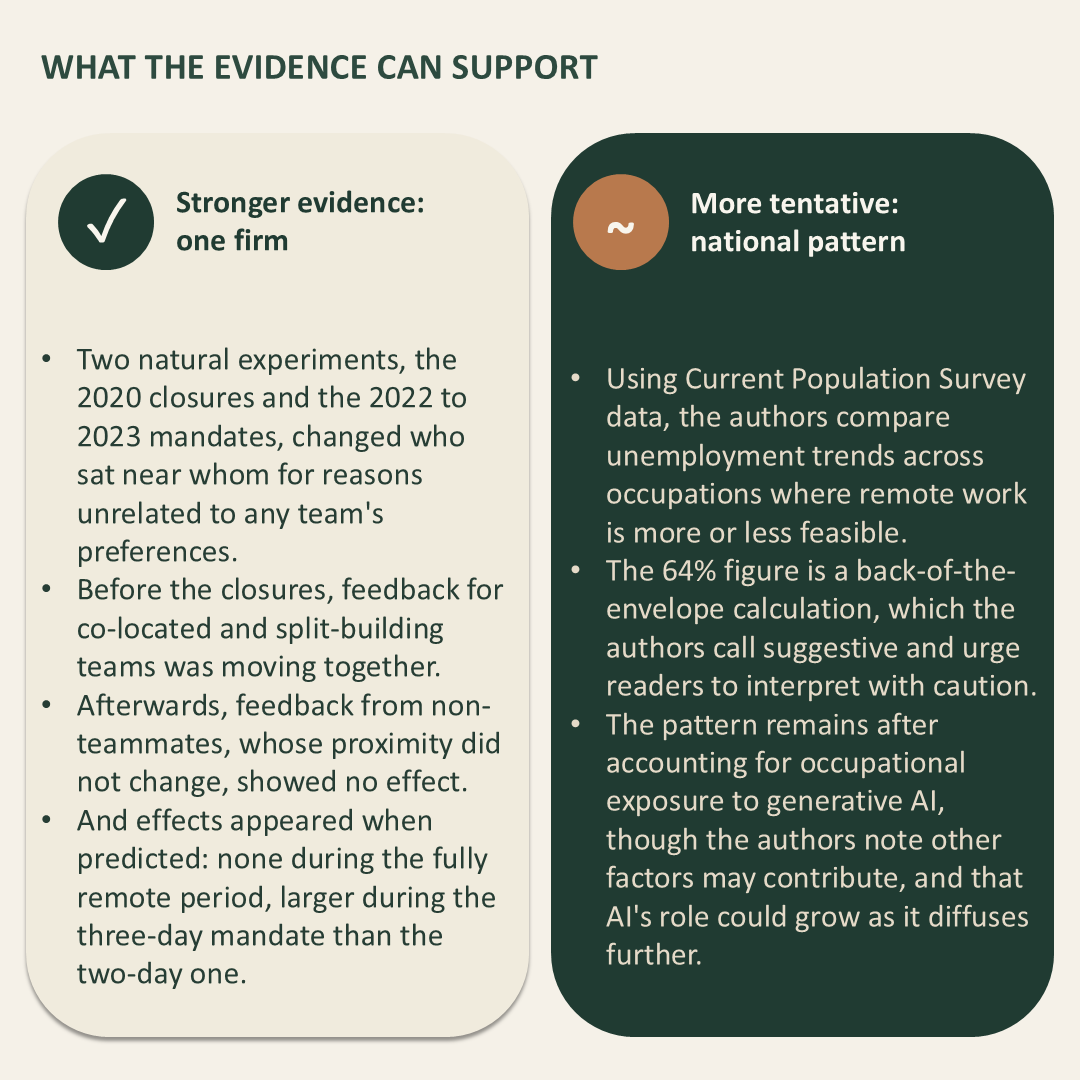
Several checks support this approach. Feedback trends were parallel across team types before the closures. This is consistent with the design’s key assumption: absent the office closures, feedback for both team types would have continued to move together over time. Feedback from non-teammates shows no effect at all. These colleagues experienced no change in proximity to the engineer under study, so this result rules out the alternative explanation that co-located engineers simply needed more feedback in general. Finally, the timing aligns with two testable predictions from the return-to-office design. The effect on code quality should be roughly zero during the fully remote period, when office assignments were irrelevant. It should be larger during the second return-to-office than the first, because the second mandate required more days in the office. Both predictions hold.
Proximity is more fragile than it sounds
A few findings in this paper reveal how easily the effects of proximity break down.
A 10-minute walk between two buildings on the same campus reduces feedback as much as being multiple states away. Teams split across the firm’s two headquarters buildings received no more feedback than teams spread across the country, even though the split-building teams all worked on the same campus. Both groups received less feedback than teams that shared a single building.
A single teammate in another building can pull an otherwise co-located team into virtual meetings. Many teams followed a “one Zoom, all Zoom” norm: if even one teammate could not be physically present, everyone else pulled out a laptop and joined the meeting virtually rather than meeting in person. Engineers in the same building exchanged 14.5% less feedback when even one teammate sat in another building, compared to pairs whose whole team shared a location. The same pattern appears even among engineers who never stop being co-located: when a new hire couldn’t be seated near the rest of the team, converting a co-located team into a multi-building one, feedback between the original teammates who still sat together fell noticeably. Adding a new hire who did not disrupt the team’s seating produced no such drop.
Losing proximity also does not just trim marginal or nitpicky comments. Using a machine-learning model trained on human-labeled reviews, the authors find that the comments lost when proximity disappeared were disproportionately those the model predicted to be helpful, well-reasoned, actionable, and likely to change the code. The drop in these comments was 21%- 23%, larger than the 18.3% drop in overall comments.
Women appear to benefit particularly from proximity. While offices were open, women on teams that sat together received more feedback than the men on their teams. Women on teams split across buildings received less feedback than their male teammates. When the offices closed, women on co-located teams lost 3.71 more comments per program than women on teams that were already split across buildings, equal to 38.9% of the feedback they had been receiving. The corresponding difference for men was 1.01 comments, or 13.1%. Relative to the same comparison group, women also received feedback from 14.7% fewer people per program once proximity disappeared, compared with a 2.6% decline for men. The authors say this is partly because women appear more reluctant to seek feedback from colleagues when working remotely.
Mentoring is not free, and senior engineers pay for it
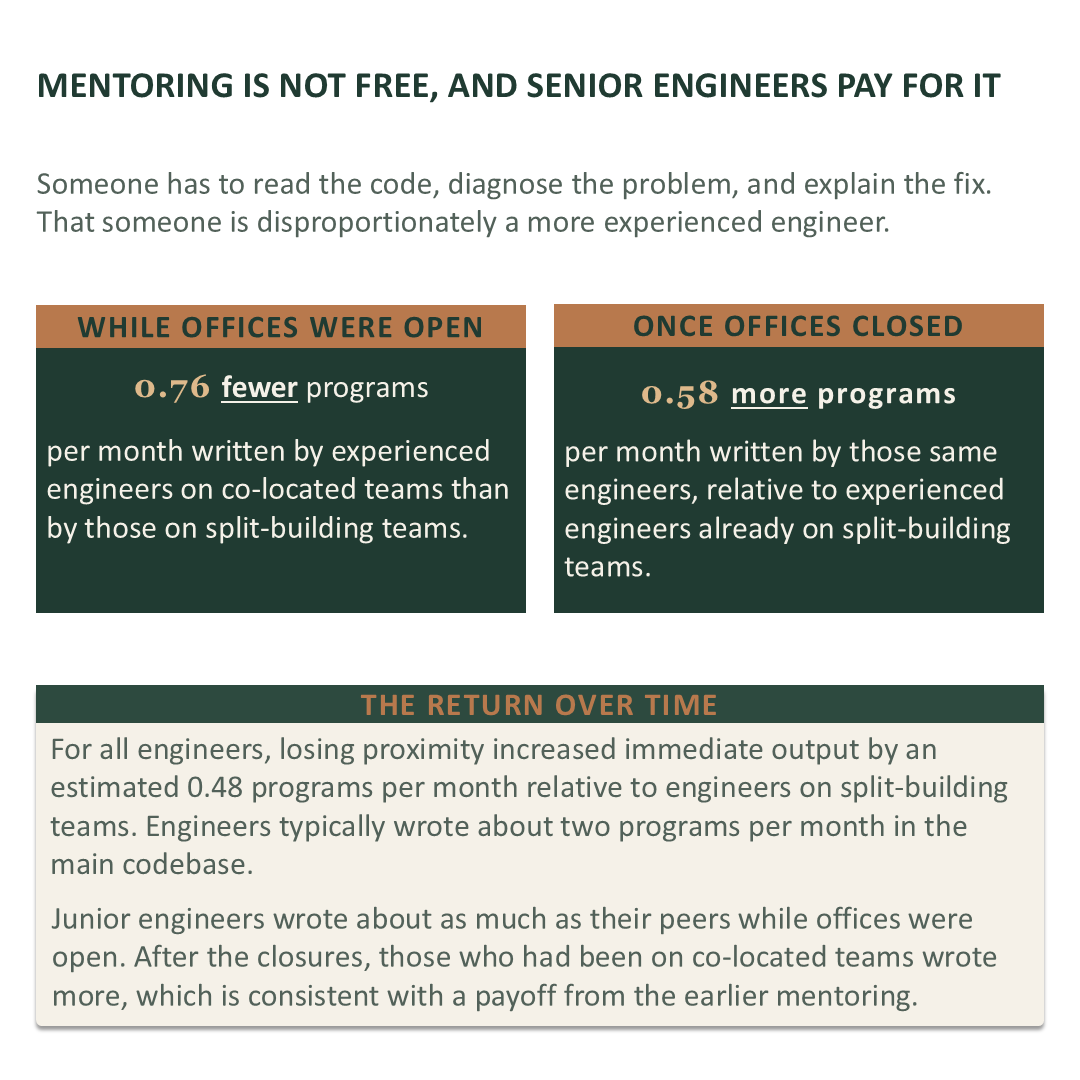
Feedback does not materialize out of nowhere. It has a time cost. Someone has to read the code, diagnose the problem, and explain the fix, and that reviewer is disproportionately likely to be a senior engineer. While offices were open, senior engineers on co-located teams wrote 0.76 fewer programs per month than senior engineers on multi-building teams. Once the offices closed and mentoring largely stopped, the gap disappeared, and senior engineers who had lost proximity to their teammates increased their output by 0.58 programs per month. The same reversal appears around return-to-office mandates, where senior engineers on co-located teams again wrote fewer programs than those on geographically distributed teams.
Junior engineers show the opposite pattern. They write about the same amount of code whether co-located or distributed while offices are open, since mentoring changes how much they learn, not how much they produce in the moment. Once offices closed, engineers who had previously been co-located and had received more mentoring wrote more code afterward, suggesting that the earlier investment paid off even after everyone was on equal remote footing.
This dynamic also shows up in who actually chooses to come into the office. During the return-to-office periods, engineers under 29 came in far more often than older colleagues, especially on co-located teams. Engineers over 40, who likely do much of the mentoring described above, also showed elevated attendance on co-located teams than similarly aged engineers on distributed teams. The result is a U-shaped pattern by age: attendance tied to proximity is highest at the start and the far end of a career, and lowest in between.
Why firms might under-invest in mentorship
Mentoring carries a second cost, separate from time: the firm that pays for it may not be the one that reaps the reward.
During the office closures, engineers who had spent more time on co-located teams and had therefore absorbed more mentoring were more likely to be poached by other firms. Among engineers on co-located teams, 1.2% were poached each month, compared to 0.9% of similarly tenured engineers on multi-building teams. That gap compounds over time. By the end of the closures, nearly 25% of previously co-located engineers had been poached, compared with about 17% of multi-building engineers. The difference was concentrated among younger engineers, whose skills were more transferable across firms.
This creates an incentive problem that economists have understood since Gary Becker’s foundational work on human capital. If a firm trains a worker in skills that make that worker more valuable to other employers, too, not just to the firm doing the training, competitors can bid that worker away without ever paying for the training themselves. The firm that invested in the mentoring gets none of the return once the employee leaves. Even a firm that could perfectly observe how much its senior engineers were investing in junior ones would still have reason to under-invest in that mentoring, because it cannot fully capture the value it creates. The social bonds that come from working near someone every day may be part of what convinces senior engineers to mentor anyway, whether or not the firm has designed the right incentives for it.
Where this evidence is strong, and where it is suggestive
The firm-level results in this paper rest on a comparison designed to rule out other explanations, and they apply most directly to a specific kind of workplace: young, highly educated, disproportionately male software engineers at one Fortune 500 online retailer, working in an open-office environment that made informal, desk-side interaction easy when people were actually present. Before the pandemic, engineers in this sample were, on average, 29 years old with just 1.4 years of tenure at the firm. That represents a workforce with a substantial amount of learning left to do, and this may be one reason the effects observed here are so large.
The national unemployment claim that remote work accounts for 64% of the rise in unemployment among young college graduates rests on a different and suggestive form of evidence: a comparison of unemployment trends across remotable and non-remotable occupations, adjusted for age and year effects, using Current Population Survey data, rather than the firm’s clean natural experiments. The authors themselves urge caution here, noting that the national pattern should be interpreted carefully. They test whether the trend can be explained by generative AI displacing junior workers by using an independent measure of occupational exposure to AI, and find that the remote-work pattern holds up after controlling for it. However, they also note that AI’s labor market effects may become more defining as technology diffuses. So, this finding reflects the period studied, and other forces may play a larger role going forward.
So, what?
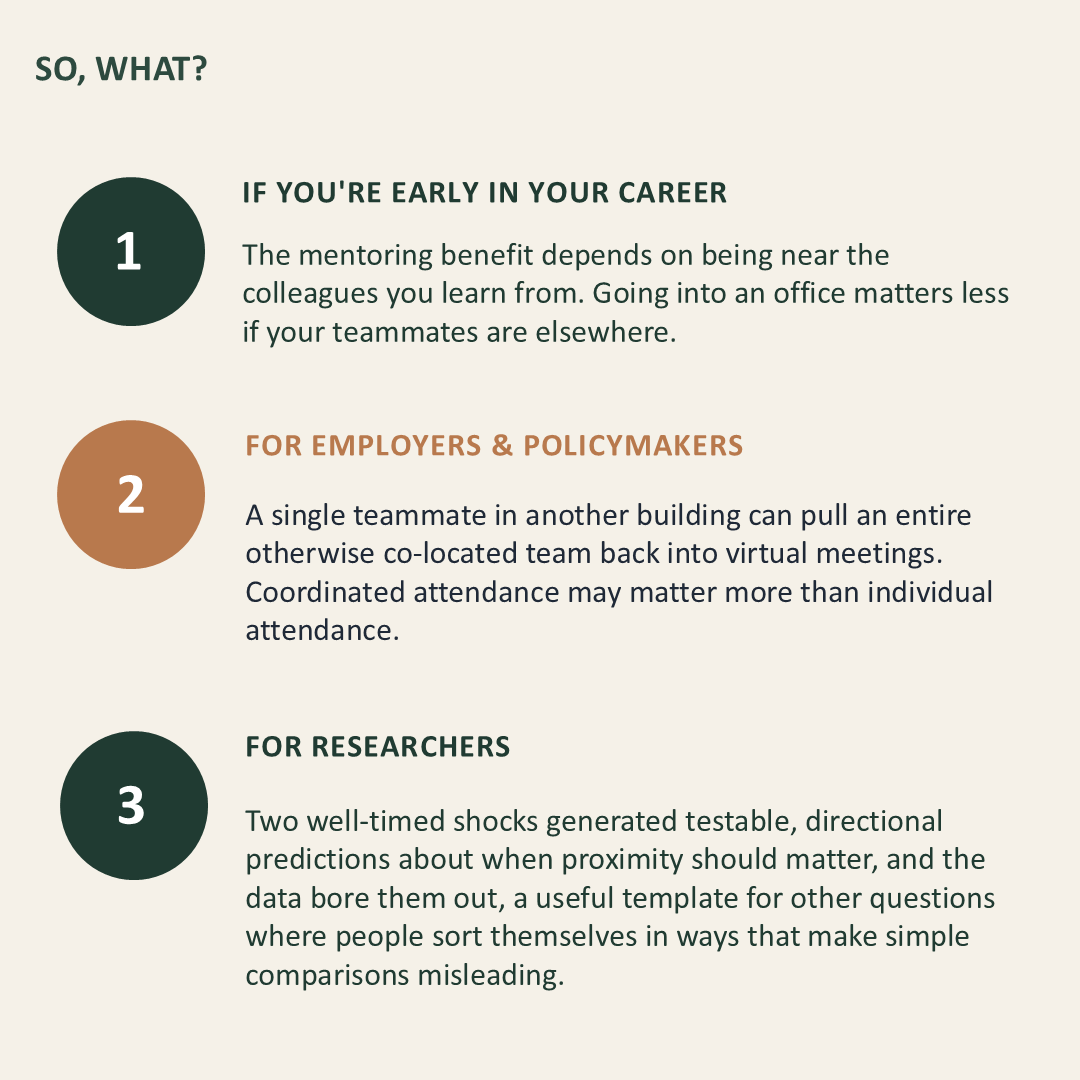
For anyone early in a career, the practical lesson is not “always go into the office.” It is that proximity only works if the people you learn from are there too. Sitting in an empty office while your team works from three different cities delivers none of the benefits this paper documents. If you are trying to build skill quickly, the question is not where your desk is, but where your mentors are.
For employers and policymakers thinking about office policy, the most actionable finding here may be the “one Zoom, all Zoom” result. Individual return-to-office mandates are fragile. A single remote teammate can pull an entire otherwise co-located team back into virtual meetings, erasing much of the benefit that bringing everyone else in was meant to produce. Coordinated attendance, not just individual attendance, is what this paper suggests recovers the mentoring benefit. The poaching finding also points to a harder problem: if firms cannot capture the full return on the mentoring they encourage, they have less reason to reward it. That may be worth considering more broadly in compensation design, since systems built around individual or relative performance, like the one at this firm, may be poorly suited to rewarding the time senior employees spend teaching others.
For researchers, the contribution is methodological and substantive. Using two distinct, well-timed shocks, office closures and staggered return-to-office mandates, the authors generate testable, directional predictions about when proximity should matter and when it should not, and the data bear those predictions out. That kind of verifiable design is a useful template for studying other questions in which people or groups sort themselves into different situations for reasons related to the outcome being studied.
The paper’s bigger point is that remote work can change who gets to learn on the job, who is most productive today, and which workers firms choose to hire. In this paper’s setting, junior engineers lose some mentoring, senior engineers gain immediate coding capacity, and national evidence suggests that young job seekers in remotable occupations may face greater difficulty entering the labor market.