
What economists found when they tracked 1,676 students, their homework, and their hidden barriers to learning.
The short version: The gap between struggling students and their peers is not about effort. It is about learning speed. And learning speed responds to better schools and better instruction.
The research, in slides (swipe or click through)
The Wrong Diagnosis
When a student consistently skips homework and bombs tests, the diagnosis is usually the same: she doesn’t care. Maybe her parents don’t push her. Maybe she’s checked out. The fix, then, is motivation, a reward system, a pep talk, information about what a college degree is worth.
A new paper in the Journal of Political Economy suggests that diagnosis is often incomplete and sometimes inaccurate.
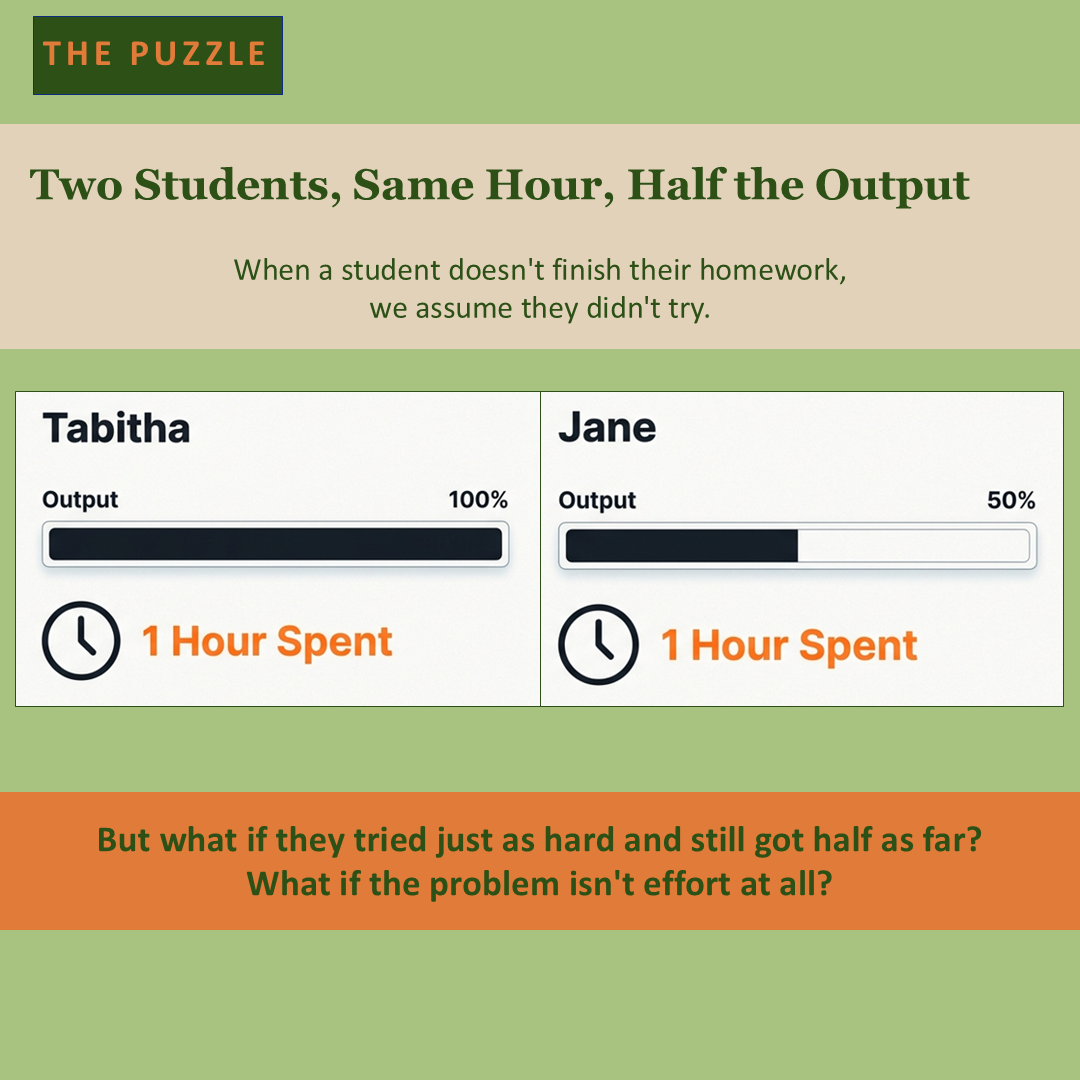
Consider Jane and her classmate Tabitha, two sixth graders the researchers use to illustrate their argument. Tabitha completes 100% of her math assignments; Jane completes half. The obvious conclusion is that Jane is less motivated. But the researchers show this isn’t the only explanation and may not even be the most likely one. If Jane is sufficiently less productive than Tabitha, meaning it takes her significantly longer to work through each problem correctly, she may rationally stop before finishing her homework even if she wants to succeed just as badly. The math simply stops working in her favor before she gets to the end of the assignment.
The economists tested this idea with real data from over 1,600 fifth and sixth graders and found that on average, low-performing students are not less motivated than high-performing ones. The gap is in productivity, meaning how efficiently a student converts time at the desk into correctly solved problems. This distinction between motivation and productivity has real consequences for how we think about helping kids who are falling behind.
Why This Has Been So Hard to Study
The problem is that motivation and productivity look identical from the outside. A student who skips her homework because she doesn’t care and a student who skips it because it takes her twice as long to solve each problem correctly will show up the same way in a gradebook. Standard observational data, the kind schools and researchers typically have access to like gradebooks and homework completion rates, record what students produce but not how many hours they spent at their desk or how mentally taxing they found the work. Without tracking time and effort, these two very different explanations are impossible to separate.
That’s the gap this research fills.
The method, plain English
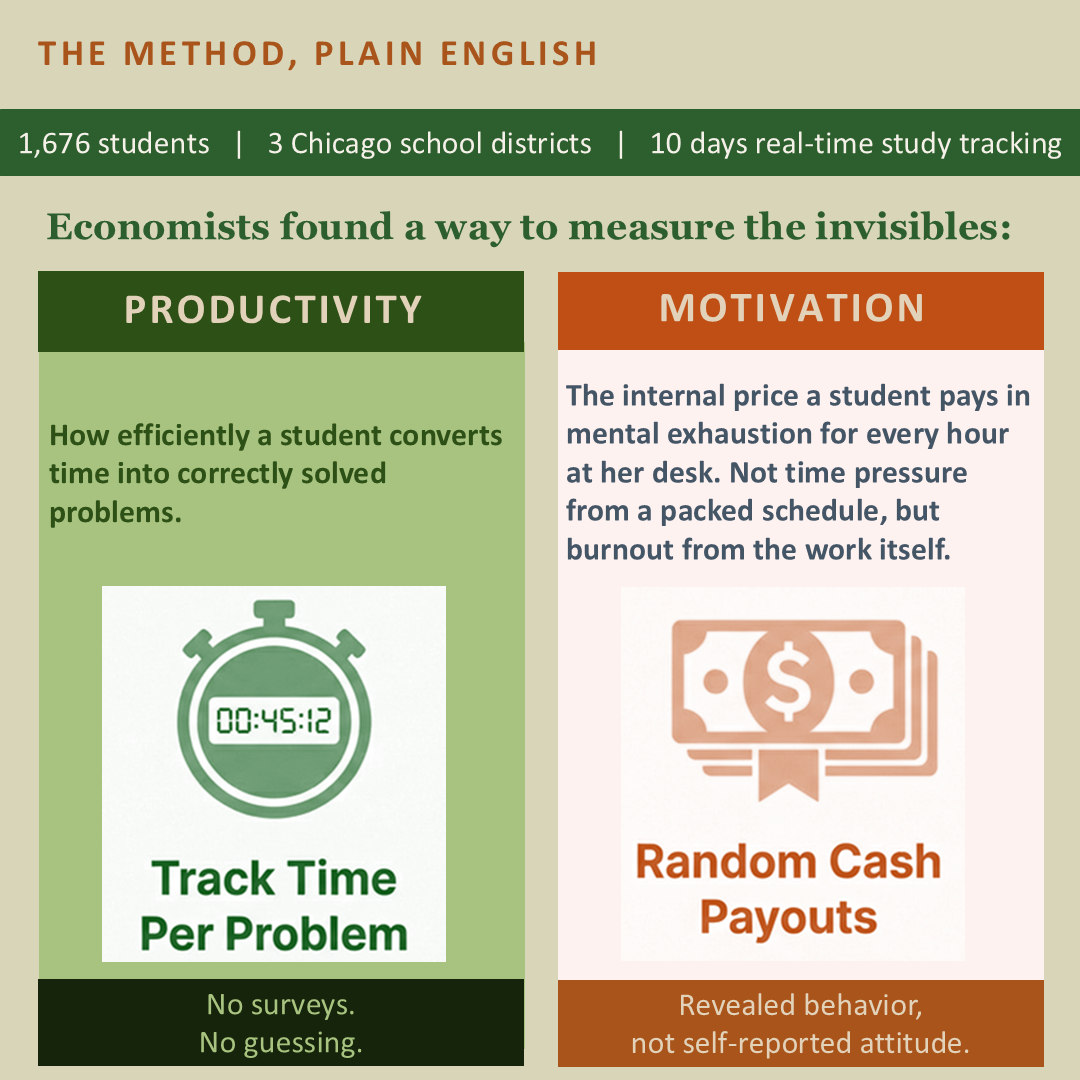
Economists tracked 1,676 fifth and sixth graders across three Chicago-area school districts. For ten days, students were given access to a custom-built math website they could use outside of school. There were 80 possible tasks, and students could do as many or as few as they wanted. Each task was a mini challenge: six math problems randomly selected from a pool of over 600. To pass a task and earn a reward, a student had to get at least five out of six correct. Because the website showed only one problem at a time, it generated a precise, real-time log of exactly how long a student spent on every single question.
This time data is what makes this study novel. While most researchers rely on student surveys, which are often inaccurate because kids can’t perfectly recall their study time, this website recorded effort directly. This, in turn, allowed the researchers to filter out day-to-day variation in difficulty or focus (like a student getting distracted or hitting an unusually hard problem) to estimate their true productivity, or underlying learning speed, as a consistent trait that didn’t change based on how they were feeling that day.
In this study, motivation isn’t a personality trait like grit or passion. Instead, the economists use it to measure the internal price a student pays in boredom and exhaustion for every hour she spends at her desk. A highly motivated student is simply one for whom that mental price is very low. To measure motivation, the researchers used a classic economic tool: they paid the students. However, they didn’t pay everyone the same. Students were randomly assigned to one of three payment contracts that varied the base pay as well as the per-task reward. Because the incentives were randomly assigned, differences in how students responded to higher versus lower rewards revealed each student’s willingness to work. If two students both had the same learning speed (productivity), but one did way more work because of the higher pay, that student was clearly more motivated. By comparing these groups, the team could finally see motivation and productivity as two distinct traits that interact to determine whether a student succeeds or falls behind.
What They Found
Motivation and Productivity Are Not the Same Thing
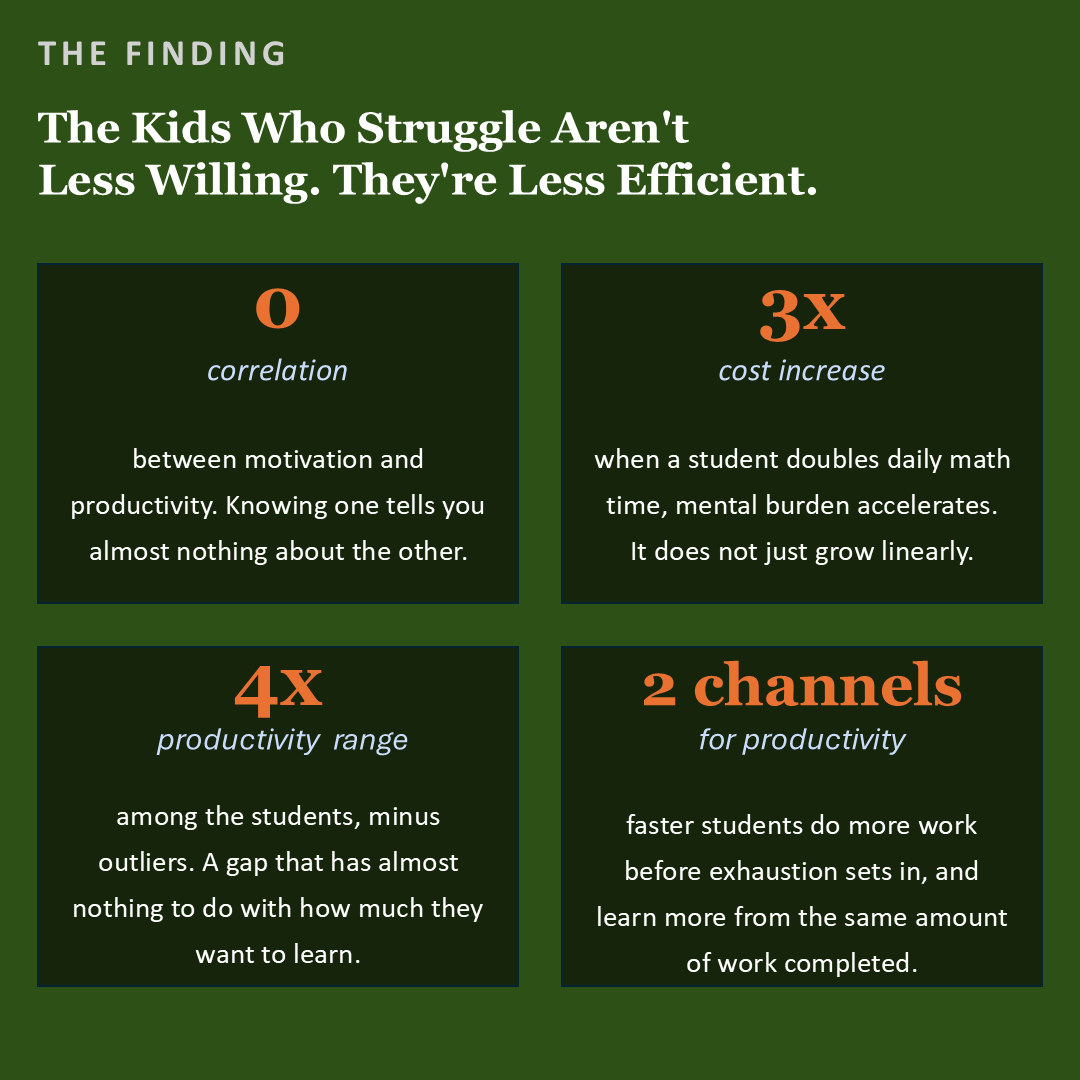
The results were striking. Across more than 1,600 students, the researchers found that motivation and productivity have almost nothing to do with each other. Knowing a student is highly motivated tells you very little about how efficiently she learns, and vice versa. In fact, it is common for high achievers to be exceptionally hard-working even if they are not naturally gifted or fast learners. Many succeed through high motivation rather than natural speed.
The Real Reason Students Struggle
More importantly, the economists found that low-performing students are not, on average, less motivated than high-performing students. Students in the bottom third of test scores took significantly longer to work through the same problems as students in the top third, even when their willingness to study was exactly the same. For these students, homework becomes so time-consuming and mentally exhausting that stopping before finishing becomes the rational choice. The effort required to complete the work outweighs the reward before they ever get to the end. The economists put a number on this. Doubling a student’s daily math commitment causes the internal mental cost of studying to rise by more than three times. The burden doesn’t grow in step with the time. It accelerates.
Differences Across Students
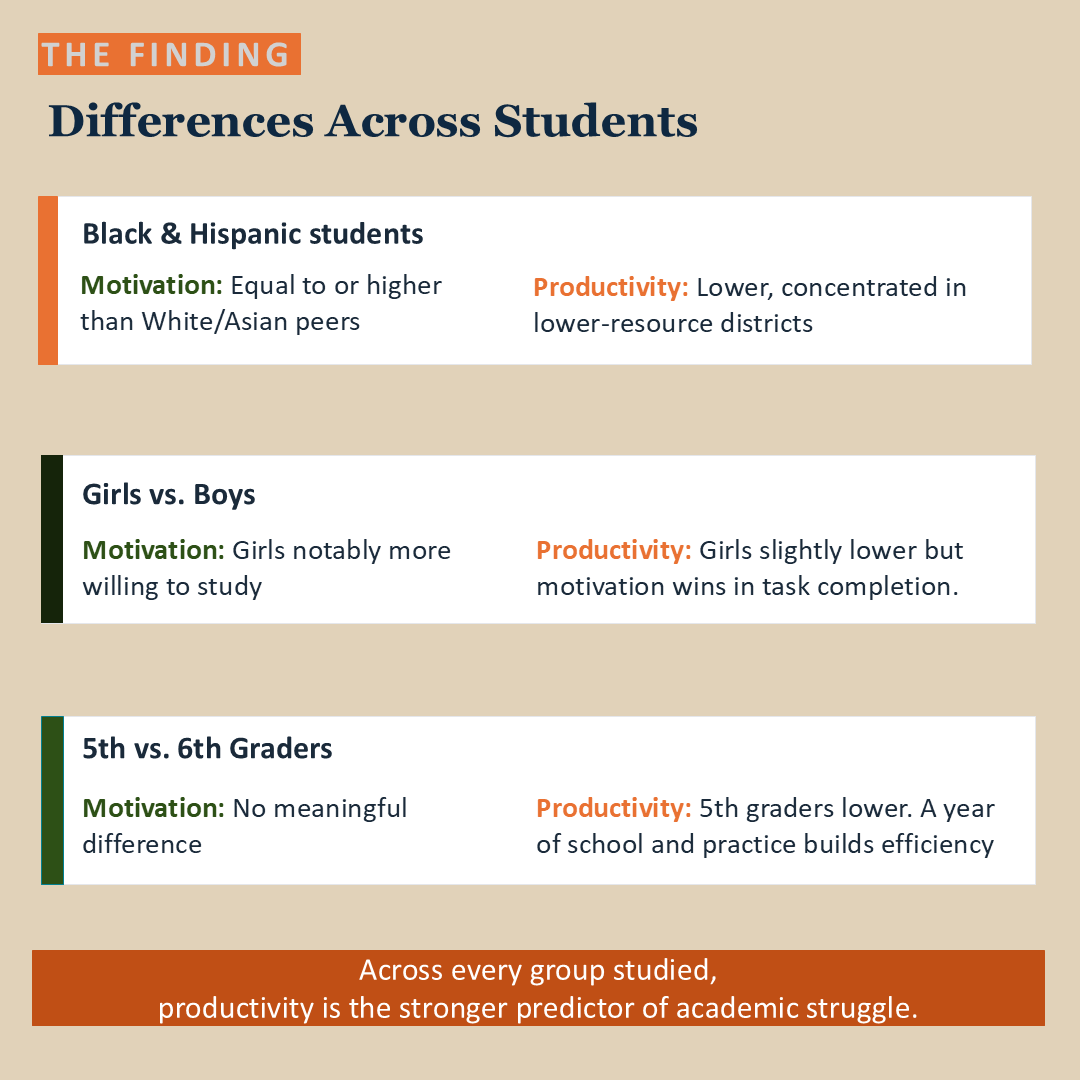
The data also revealed some striking patterns across demographic groups. Black and Hispanic students in the sample were at least as motivated as their White and Asian peers, and in some cases more so. They were more likely to report math as a favorite subject and showed higher levels of intrinsic motivation on average. The gap that explained their lower test scores was not a lack of willingness to study but a productivity disadvantage, one that the researchers trace largely to the fact that Black and Hispanic students were concentrated in lower-resource school districts. Girls, meanwhile, showed higher motivation than boys on average but lower productivity, with motivation ultimately winning out in terms of how much work they completed. Fifth graders were less productive than sixth graders on average but equally motivated, suggesting that an additional year of schooling and maturation builds learning efficiency without necessarily changing a student’s underlying drive.
Schools as Force Multipliers
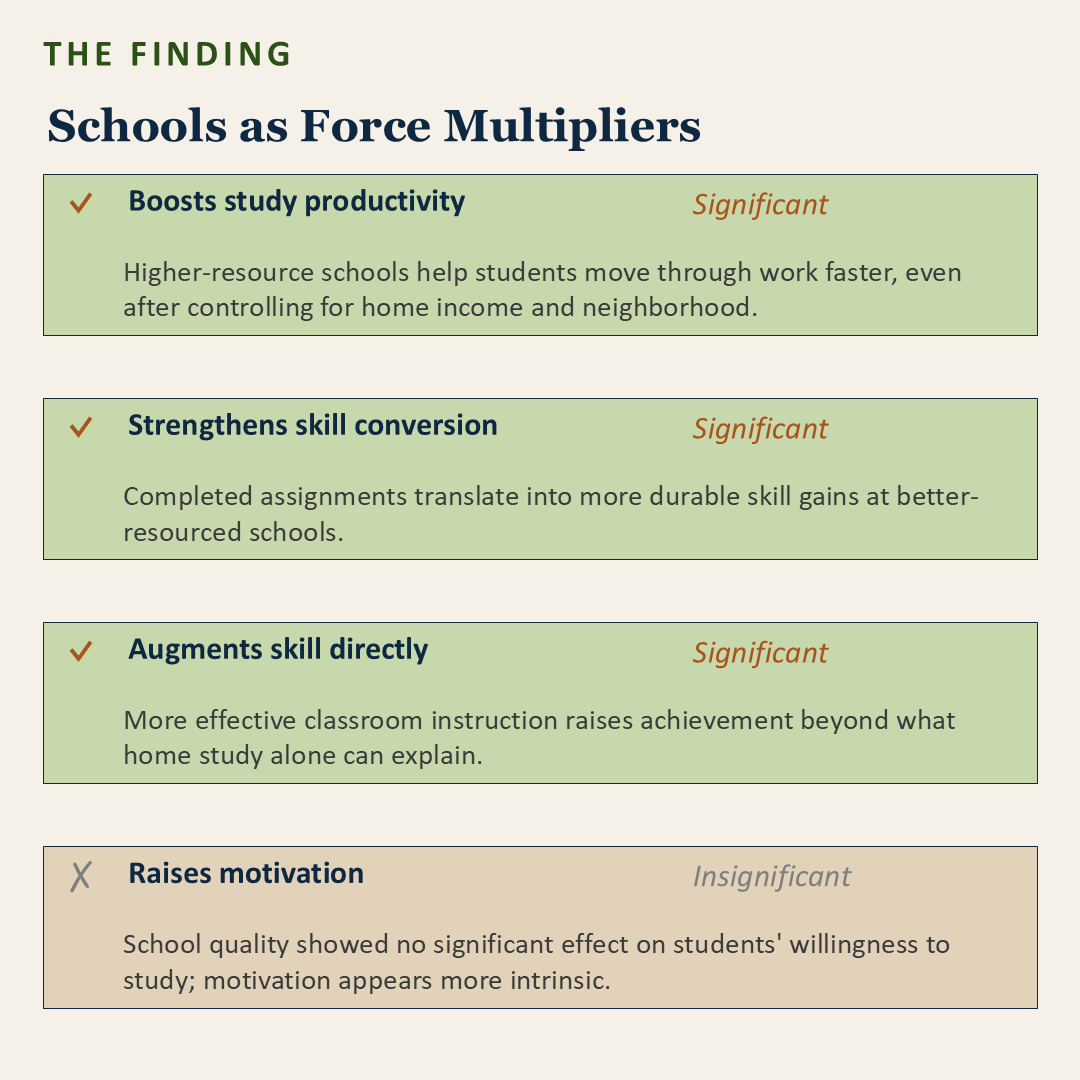
School quality mattered deeply, but not by changing how much students cared. Attending a higher-resource school did not make students more motivated. It made them more productive. Better tools and instruction allowed students to move through work faster and convert completed assignments into more durable skill gains than students in lower-resource districts experienced.
Volume Over Time
The study also confirms that time at a desk is not what drives learning. What actually builds skill is the volume of problems a student correctly solves. As students practice and solve more problems, they become more efficient, which makes future studying feel less costly and encourages them to do even more.
Productivity Is Not a Fixed Destiny
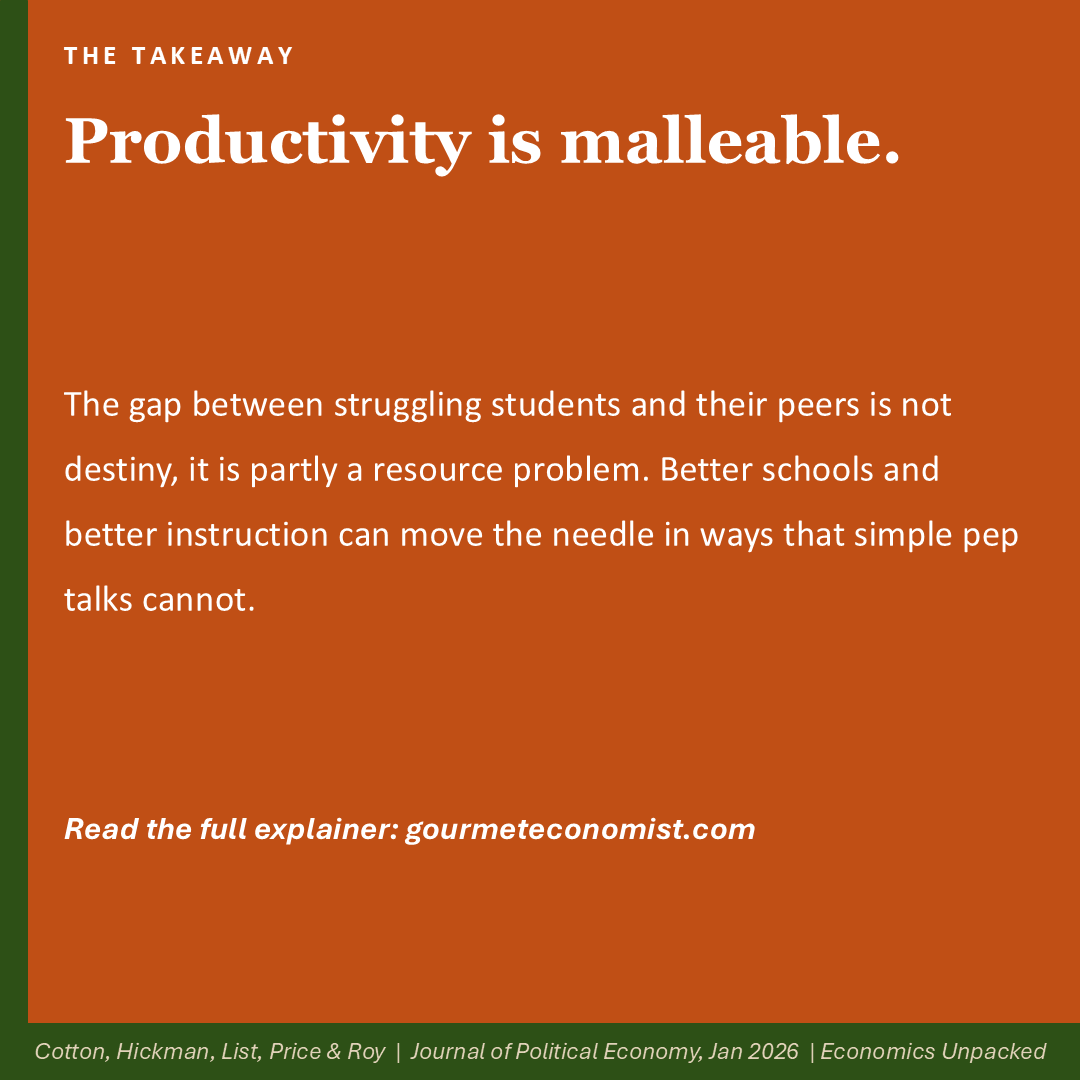
The most important takeaway is that productivity is malleable. It responds to school quality and to learning experience. That means the gap between struggling students and their peers is not inevitable. It is, at least in part, a resource problem.
What This Study Can and Can’t Tell Us
The study has real strengths but also some limitations worth noting. The sample focuses on fifth and sixth graders in three Chicago-area school districts doing optional math work for cash rewards. This context matters. What the economists measured was students’ willingness to do extra work beyond their normal load, and students may behave differently when facing the consequences of traditional schooling rather than the prospect of a financial bonus.
That said, the economists make a compelling case for why their findings travel beyond the website. Regular school rewards, including grades, college admissions, and job prospects, work the same way as the website’s payment structure. In both cases students are rewarded for outcomes, not hours spent. That means the relationship between productivity and motivation should operate the same way in a classroom as it did in this study. And because the researchers anchored their measurements in time and money rather than arbitrary test score scales, the framework is grounded in units that translate across subjects and age groups.
The fundamental finding, that motivation and productivity are distinct traits and that productivity is the stronger predictor of struggle, offers a new way of seeing why some students fall behind, even if the precise numbers would shift in a different classroom or context.
So What Does This Mean?
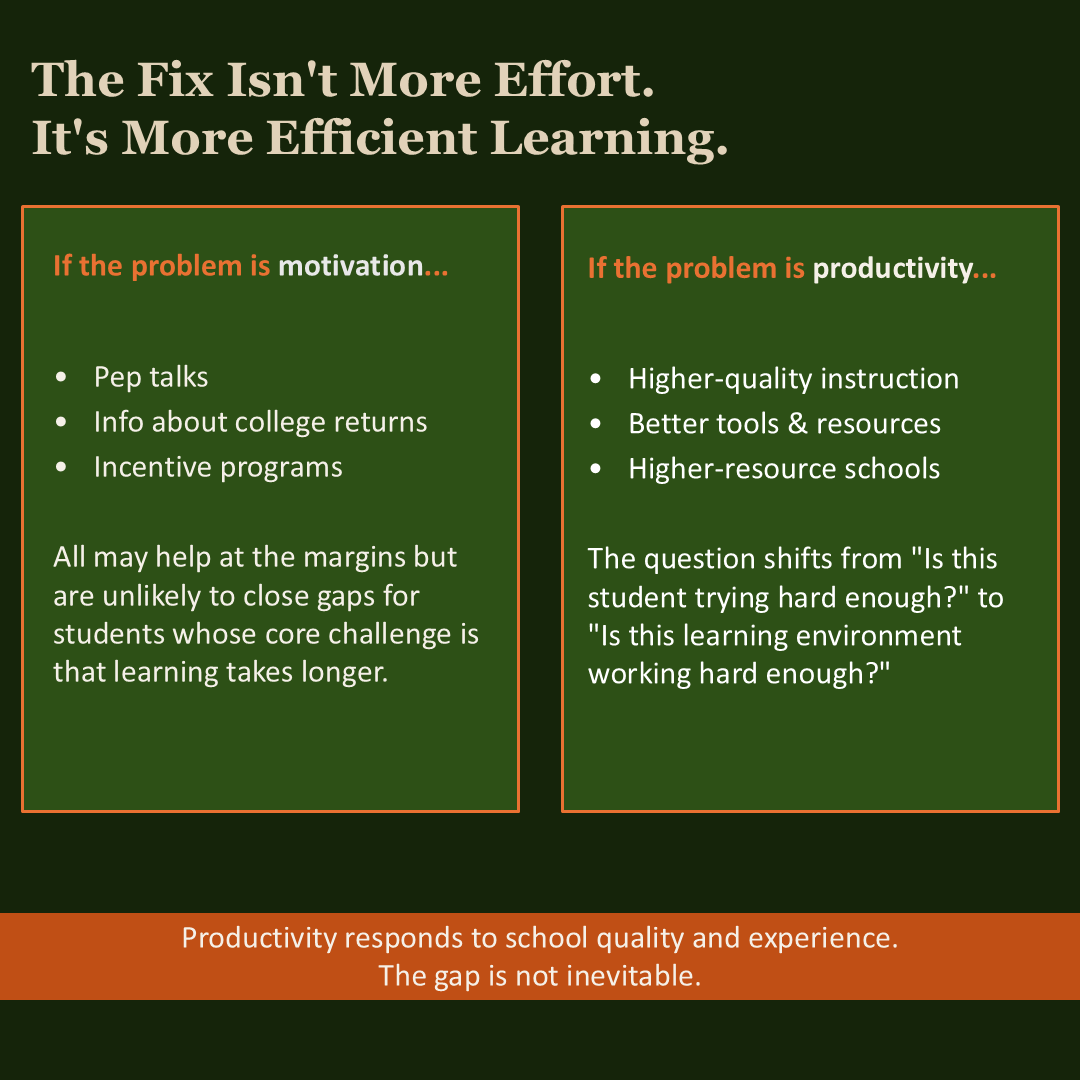
The practical implication of this research is uncomfortable for anyone who has ever told a struggling student to just try harder. If productivity, not motivation, is the primary driver of academic struggle, then interventions built around effort and incentives are targeting the wrong problem for many students. Cash rewards for good grades, motivational programs, and information campaigns about the returns to education may help at the margins, but they are unlikely to close the gap for students whose core challenge is that learning simply takes them longer.
For a low-productivity student, completing a full assignment may require such an extreme time commitment that stopping before reaching the end becomes a logical response rather than a character flaw. The work is not impossible because the student doesn’t care. It is impossible because the mental and physical cost of finishing has grown too large to bear. Telling that student to try harder misdiagnoses the problem entirely.
The economists also tested whether students stop working because their schedules are too full or because they simply run out of mental energy. The data favored the latter. The average fifth and sixth grader is not stopping because they have run out of hours in the day. They are stopping because they have run out of steam. This matters because it means the barrier to more studying is internal, not logistical, and cannot be solved by clearing space in a student’s after-school schedule.
What would actually help? The economists point to school quality as the most actionable lever. Higher-resource schools boosted student productivity directly, meaning they helped students move through work faster and get more out of every hour they spent studying. That effect showed up even after controlling for household income and neighborhood characteristics, suggesting it is something about the instruction and resources themselves, not just the students who attend.
For parents and educators working with individual students, the findings suggest a shift in focus from asking whether a student is trying hard enough to asking whether the learning environment is efficient enough. A student who is struggling may not need a pep talk. She may need better tools, more targeted instruction, or simply more time to work through material at her own pace without the mounting costs of exhaustion pushing her to stop.
Closing achievement gaps requires making learning itself more productive, especially for students who are already willing to do the work but are not getting enough out of it.