
Based on: Dubé, Jean-Pierre, and Sanjog Misra. “Personalized pricing and consumer welfare.” Journal of Political Economy 131, no. 1 (2023): 131-189, https://doi.org/10.1086/720793.
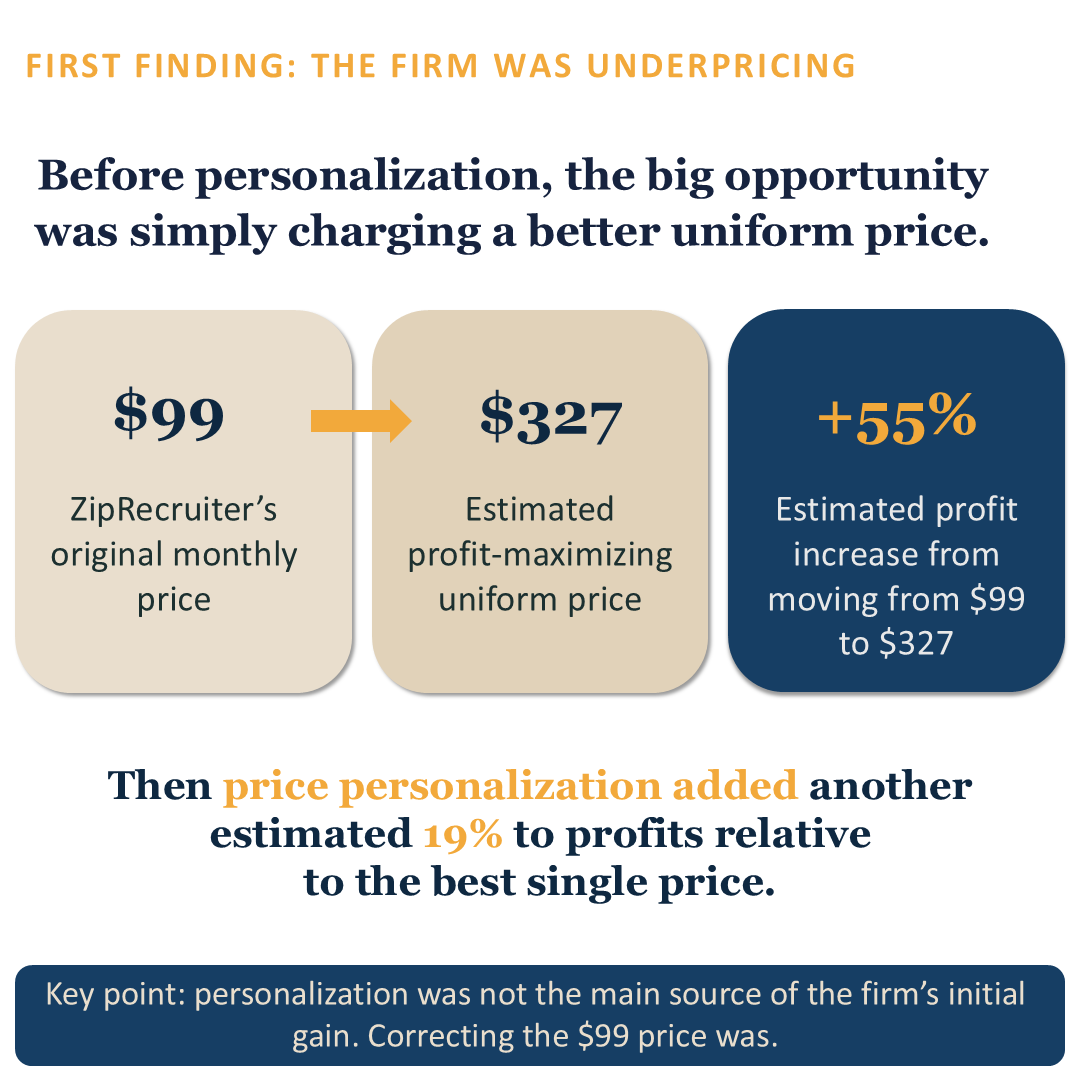
The short version: What happens when businesses use machine learning to set personalized prices based on your data? Economists partnered with the job platform ZipRecruiter to run a live field experiment on over 13,000 companies to find out. Simply raising ZipRecruiter’s uniform subscription rate ($99) to a single, data-optimized price ($327) would have boosted profits by 55%. Going a step further and letting the algorithm personalize prices boosted profits by another 19%. For ZipRecruiter’s customers, the results were mixed. Total consumer surplus – the standard economic yardstick that measures the extra value buyers get over and above the price they pay – dropped by 25%. However, despite that overall drop in consumer surplus, more than 60% of individual customers got a lower price under personalization than they would have under the $327 uniform rate.
The research, in slides (swipe or click through)
The setting
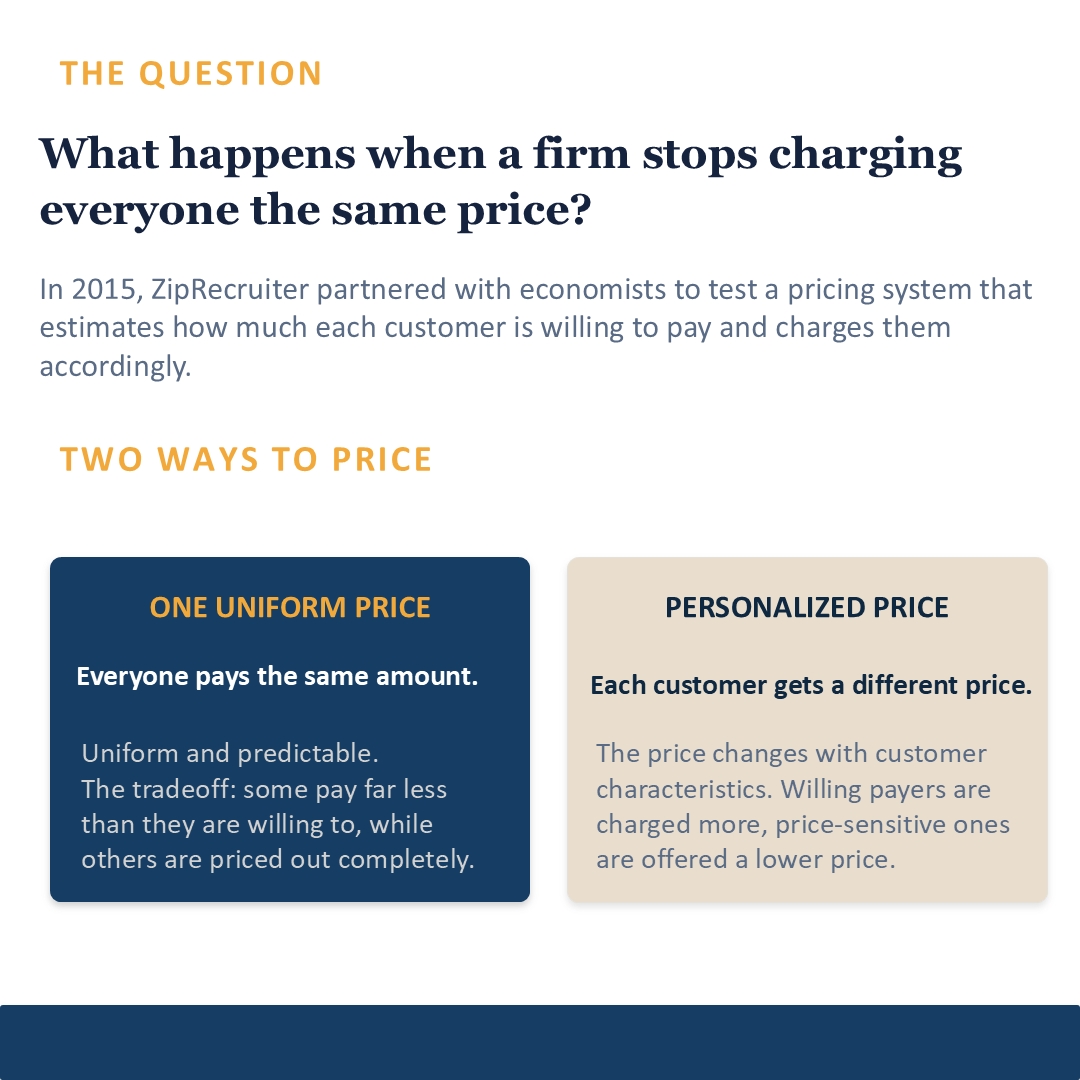
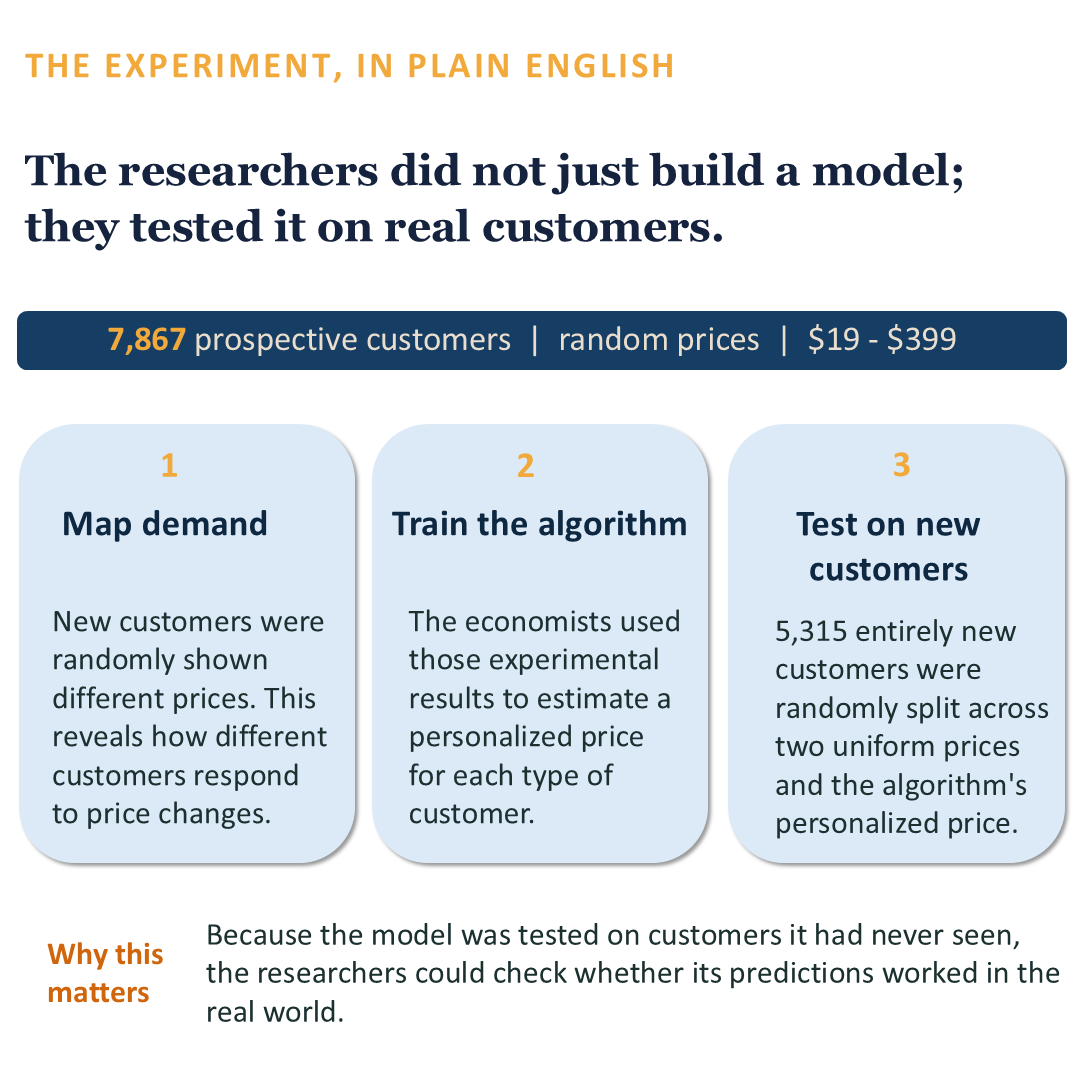
ZipRecruiter, an online platform that matches job seekers with employers, charges its business customers a monthly subscription. In 2015, the company partnered with economists to execute a unique, multi-stage pricing experiment. First, they randomized the prices shown to new customers to map out how demand changes when prices change. Then, they used that data to train an algorithm to generate personalized prices. Finally, they tested those custom rates on an entirely fresh set of customers to validate their model. The result is a rare, real-world look at what happens to a company’s bottom line, and its customers’ wallets, when algorithmic pricing moves out of the lab and into the field.
Last month, we covered DellaVigna and Gentzkow’s finding that major retail chains leave millions on the table by charging the same price across stores, regardless of local market conditions. This paper picks up a related but distinct question: what happens when a firm goes the opposite direction, and starts charging a different price to every individual customer?
What the paper found
Among the roughly 7,900 prospective customers used to build ZipRecruiter’s demand model, the researchers estimated that the profit-maximizing uniform price would have been about $327 per month, compared to $99 per month that it was charging prior to the experiment.
Personalized pricing increased the company’s expected profit per customer by 19% relative to the profit-maximizing price and by 86% relative to its prior uniform rate of $99 per month.
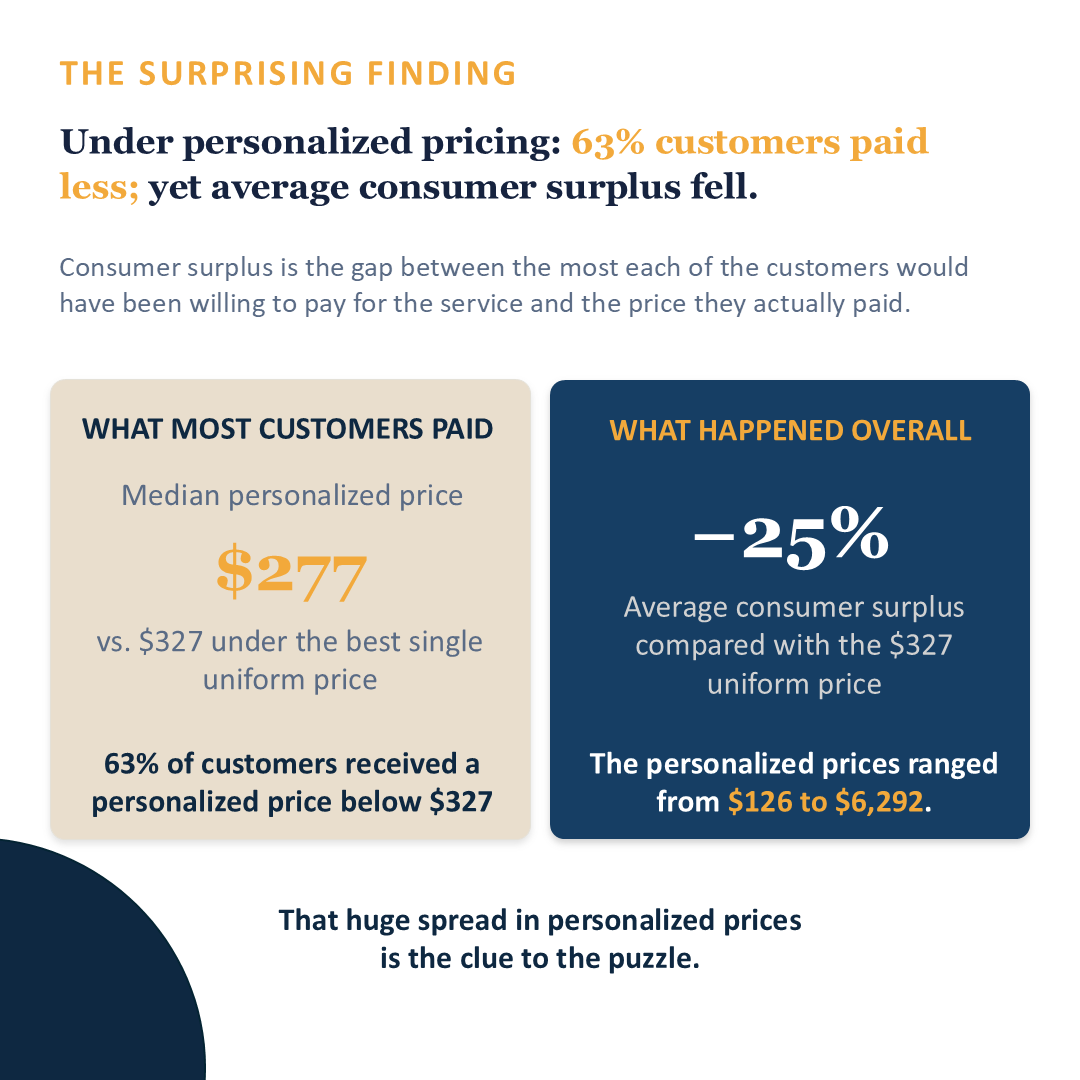
On the consumer side, personalization reduced total consumer surplus (the total gap between the maximum each customer would have been willing to pay for the service and the price they actually paid) by 25% relative to the optimal uniform price. However, this aggregate picture on the consumer side hides the variation in prices among consumers. Personalized prices ranged from $126 to $6,292, but the median personalized price was $277, well below the optimal uniform rate of $327.
In this setting, customers who receive a personalized price below the $327 benchmark generally experience more consumer surplus than they would under the uniform price; in other words, they benefit from personalization. The authors’ welfare calculations show that this applies to most customers, even though the aggregate consumer surplus falls.
A second independent validation experiment, run a few months later on over 5,000 new customers, confirmed this pattern: nearly 70% of customers who received a personalized price were quoted a rate below the $327 uniform benchmark.
It is important to be precise about what “benefit” means here. It compares personalized pricing to the optimal uniform price of $327, not the original $99 rate. In fact, every personalized price offered in the study was at or above $99. The authors deliberately use the estimated profit-maximizing uniform price of $327 as the main benchmark, rather than ZipRecruiter’s existing $99 price. This assumes ZipRecruiter has already decided to stop underpricing and move toward a profit-maximizing price, whether uniform or personalized.
The average hides the distribution
How can a pricing policy help more than 60% of individual customers, yet cause total customer surplus to drop by 25%? This apparent tension resolves once we look beyond the average and examine the actual distribution of outcomes.
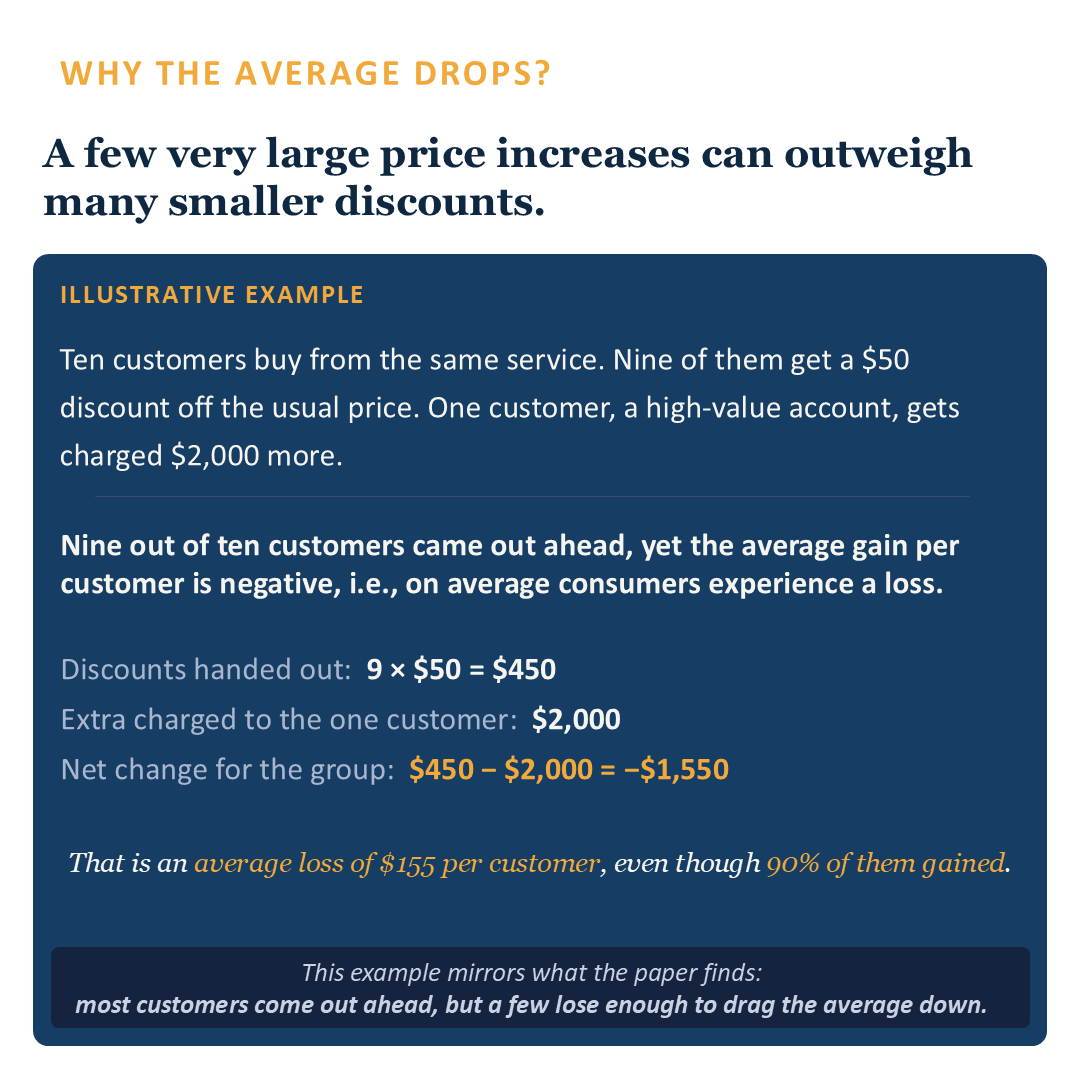
Under uniform pricing, a small number of customers with very high budgets are likely to get a significant amount of leftover value (surplus), because they are charged the same rate as everyone else. Under personalized pricing, the algorithm identifies these high-budget customers and raises their prices, sometimes to over $1,000 (and up to $6,292). Because their individual losses are so massive, they mathematically overwhelm the many smaller price cuts spread across most budget-conscious customers. In other words, a minority of large losses can dominate a majority of small gains when you simply add all the numbers together.
This is why the paper devotes significant attention to how we measure consumer welfare, rather than treating “the consumer” as a single, abstract group. Under the standard, distribution-blind way of adding up consumer surplus, every dollar is treated equally, regardless of who keeps it. By this metric, personalization appears to be a net loss for consumers because the total pool of customer value shrinks.
But the authors also calculate welfare using two alternative formulas that place more weight on customers who are worse off (referred to as “inequality-averse” metrics). Under these formulas, personalized pricing outperforms a uniform rate. This is because the price hikes are concentrated among a few higher-paying customers, while the benefits reach more people.
The paper explicitly states that choosing which of these formulas is “correct” is a value judgment about how much society should care about the distribution of outcomes, not something the data alone can settle.
Finally, the paper conducts an exploratory analysis to identify which features correlate with winning or losing under this system. Based on this simple correlational analysis, the customers most likely to receive a lower-than-uniform-rate personalized price were smaller companies and firms hiring part-time workers. Larger companies, firms hiring full-time workers, and firms offering more benefits were more likely to receive higher prices. These are correlations, not causal effects of those characteristics on price.
What “personalized price” meant in this study
The prices in this paper were not built from browsing history, location tracking, or any data gathered without the customer’s knowledge. The custom prices were built entirely from twelve basic questions that ZipRecruiter customers voluntarily answered during registration to help match them with job seekers. These questions covered simple operational details, such as: which state the job was based in, the type of company, how many positions needed filling, and what benefits, medical, dental, vision, and life insurance, were offered.
By breaking these twelve questions down into individual yes-or-no variables, the pricing algorithm had 133 distinct characteristics it could use to estimate a buyer’s price sensitivity.
Left completely to its own devices, the algorithm’s price recommendations were highly aggressive. A quarter of its custom price quotes exceeded $399 (the highest price tested in the initial experiment), and some even crossed $1,000. Worried about both that these prices ventured far outside anything the experiment had actually tested and, more importantly, that such high prices might damage customer relationships, ZipRecruiter’s management team stepped in and capped all personalized prices at $499.
Without the cap, personalization was a major trade-off: it boosted company profits by 19% over a uniform rate, but slashed total customer surplus by 25%. With the $499 cap, the trade-off narrowed significantly. The profit gain over the uniform rate narrowed to 8%, while the drop in total customer surplus shrank to a mere 2%.
While this capped version is what ZipRecruiter actually launched in the real world, most of the headline numbers in public policy debates, and the ones we focus on in this summary, refer to the uncapped version, since that’s the algorithm’s unconstrained recommendation.
How we know this isn’t just correlation
A skeptic’s first objection to a pricing study based on historical sales data is a classic selection problem: customers who paid more might simply have been customers who were willing to pay more in the first place, rather than evidence that the higher price itself caused different purchasing behavior. In observational data, customer characteristics can be correlated with the prices they face, making it difficult to disentangle the effect of price from differences in who receives or encounters different prices. For example, in a setting where prices varied across customers, larger, more established companies might systematically differ from smaller startups in when they sign up or in the promotions they encounter. That kind of observational variation can make it difficult to determine whether differences in purchasing reflect the price itself or differences in the customers facing those prices.
To bypass this problem and isolate true cause-and-effect, the economists designed a two-stage field experiment:
Phase 1: The Randomized Demand Map
Between August and September 2015, 7,867 new prospective customers were randomly assigned to one of ten uniform subscription prices ranging from $19 to $399. Because the price assignment was entirely random, a company’s characteristics had no systematic relationship to the price they were shown. This allowed the researchers to isolate exactly how different customer types responded to different price points, free of selection bias.
Phase 2: The Out-of-Sample Field Test
Only after using this randomized data to train their machine-learning algorithm did the researchers build their personalized prices. They then ran a second, independent experiment between October and November 2015 on a brand-new batch of 5,315 prospective customers. These new customers were randomly assigned to a $99 control price, a $249 uniform price (the rate ZipRecruiter itself judged more palatable to the market than the calculated $327 optimum), or the algorithm’s personalized price.
The second experiment provided meaningful out-of-sample validation: the actual conversion rates and profits were broadly consistent with the model’s predictions. The evidence for an additional profit gain from personalization over the $249 uniform price was suggestive, although less statistically precise.
How basic demand modeling revealed a significant pricing error
Separate from the personalization question, the paper’s field experiment revealed that ZipRecruiter had been significantly underpricing its service.
The data showed that the optimal uniform price for a subscription was $327, 230% higher than the company’s original $99 rate. Simply correcting this underpricing and charging everyone that single, optimized uniform rate would have boosted ZipRecruiter’s profits by 55% on its own, without any personalization at all. In fact, a month after the first experiment concluded, ZipRecruiter raised its price to $249 and kept it there for years afterward. The paper also examined whether the estimated profit boost was merely a short-term effect, accounting for the possibility that higher prices might drive customers away more quickly, and found that the conclusion held even over a longer time horizon.
Whether more data helps or hurts consumers depends on the type of data
The paper also tests a question directly relevant to modern data-privacy regulations like Europe’s General Data Protection Regulation (GDPR) or California’s California Consumer Privacy Act (CCPA): If we legally restrict a firm from using certain categories of customer data to set prices, does that really protect the consumer?
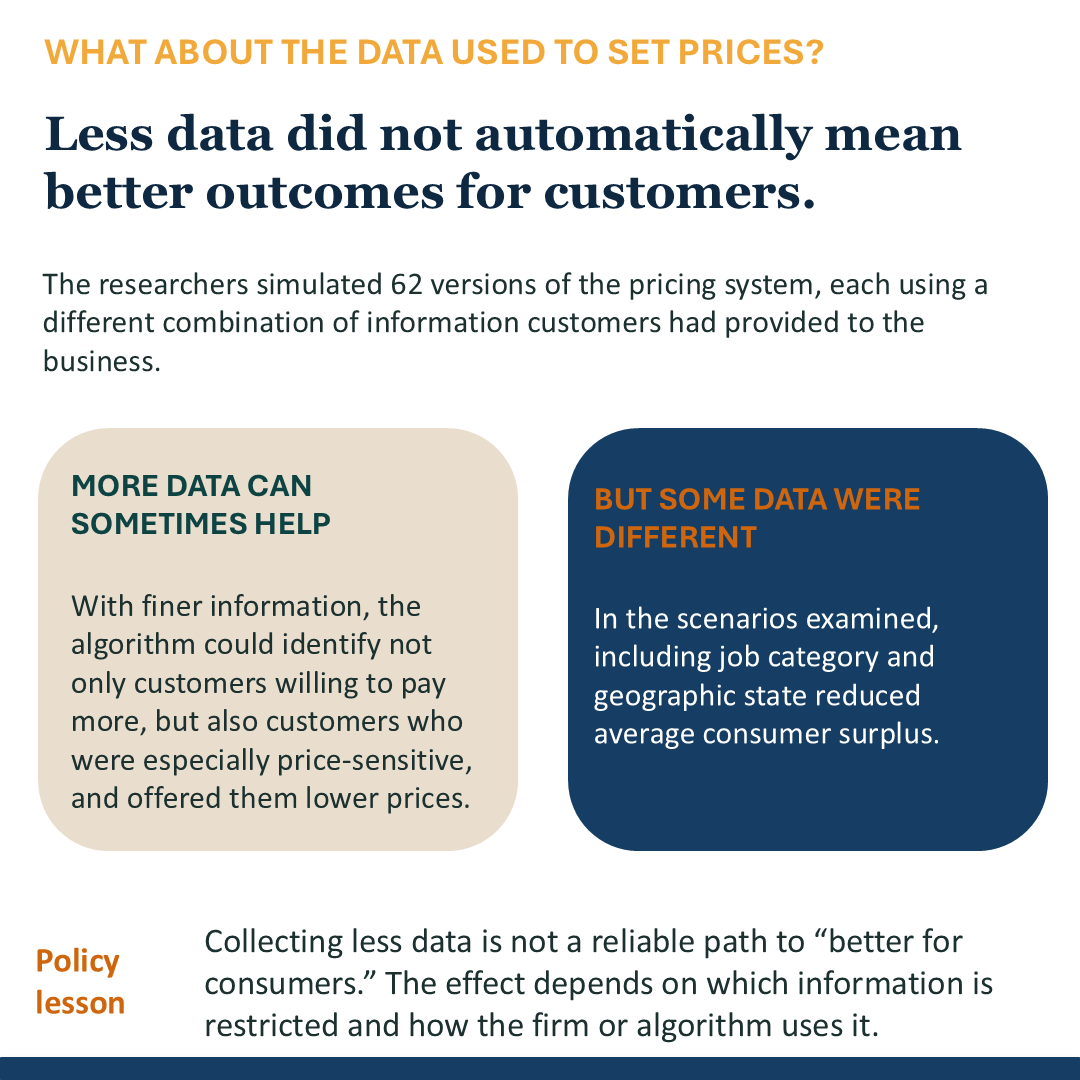
To find out, the authors simulated 62 combinations of the six broad categories of business data that ZipRecruiter collected, recomputing total customer surplus for each scenario.
The results reveal that restricting data does not consistently protect buyers. In several of the 62 scenarios tested, granting the pricing algorithm access to additional data categories increased total customer surplus. This is because when the algorithm has access to highly granular data, it doesn’t just identify who to charge a premium, it also identifies budget-conscious customers. With less data, the algorithm can no longer identify those smaller, price-sensitive businesses. Instead of offering them a lower price, the algorithm defaults to charging them a higher, coarser rate, so they end up paying a less favorable price than they otherwise would have.
In fact, the “full-feature” version of personalized pricing (using all six data categories) generated more consumer surplus than several of the artificially restricted versions the authors simulated. However, not all data behave the same way. The simulations revealed that two specific categories – job category and geographic state – reduced consumer surplus whenever they were included, in each of the scenarios the authors examined closely. A plausible reason is that these features were simply too effective at helping the firm extract surplus from high-budget segments without creating a balancing volume of low-price discounts.
Importantly, none of the 62 personalized-pricing schemes generated more total consumer surplus than optimal uniform pricing. The point is that some restrictions made consumers even worse off than other personalized-pricing schemes.
The paper’s conclusion is narrow but important for policymakers: whether restricting consumer data helps or harms buyers depends entirely on which specific category is restricted, not simply on the total volume of data a firm is allowed to use. The paper’s results complicate the assumption that restricting a firm’s use of data is automatically good for the consumers it is meant to protect
Where this finding extends, and where it does not
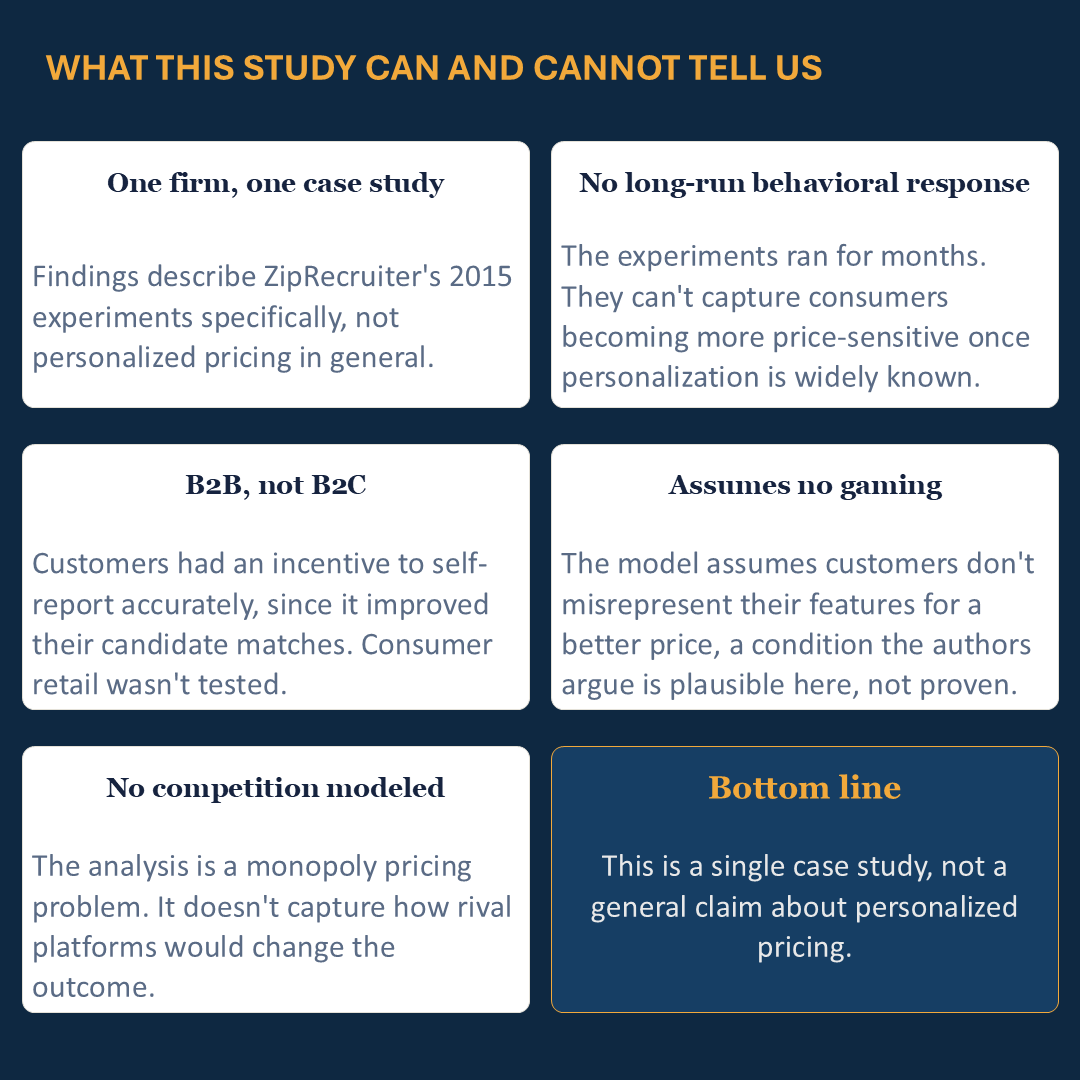
The authors are explicit that this is a single case study of one company, in one industry, one country, and one year. They flag several unique features of their setting that limit how far these results should be pushed.
First, this was a business-to-business (B2B) market. ZipRecruiter’s customers were companies that filled out detailed registration forms to be matched with job candidates. Because misreporting company characteristics would have degraded the quality of candidate matches they received, buyers had a built-in incentive to answer accurately. This incentive structure plausibly reduced the kind of gaming or strategic misreporting that could be more tempting in a business-to-consumer (B2C) retail setting, where hiding your data carries no such transactional cost.
Second, the paper studies a single firm behaving close to a monopolist in its specific market segment. The authors state directly that they do not model how personalized pricing would play out in a competitive market with rival platforms, noting that competitive pressure could push the welfare results in either direction.
Third, the study cannot speak to longer-run consumer reactions. The authors note that backlash against differential pricing, once customers become aware of it, could make demand more price-sensitive over time in ways this study, run over a period of months, would not capture. This risk may be more pronounced in B2C consumer markets, where price differences are more visible to shoppers, than in the largely private B2B context studied here.
Fourth, and perhaps most importantly, the finding that most individual customers benefited from personalization in this dataset describes what happened among the specific customers in these two 2015 experiments at this company in this market. The paper does not claim, and this summary should not imply, that a majority of consumers benefit from personalized pricing generally, across industries, countries, or customer types. The authors themselves list the extension to consumer-facing markets and to customers of different income levels as a direction for future research rather than a conclusion this paper reaches.
So, what?
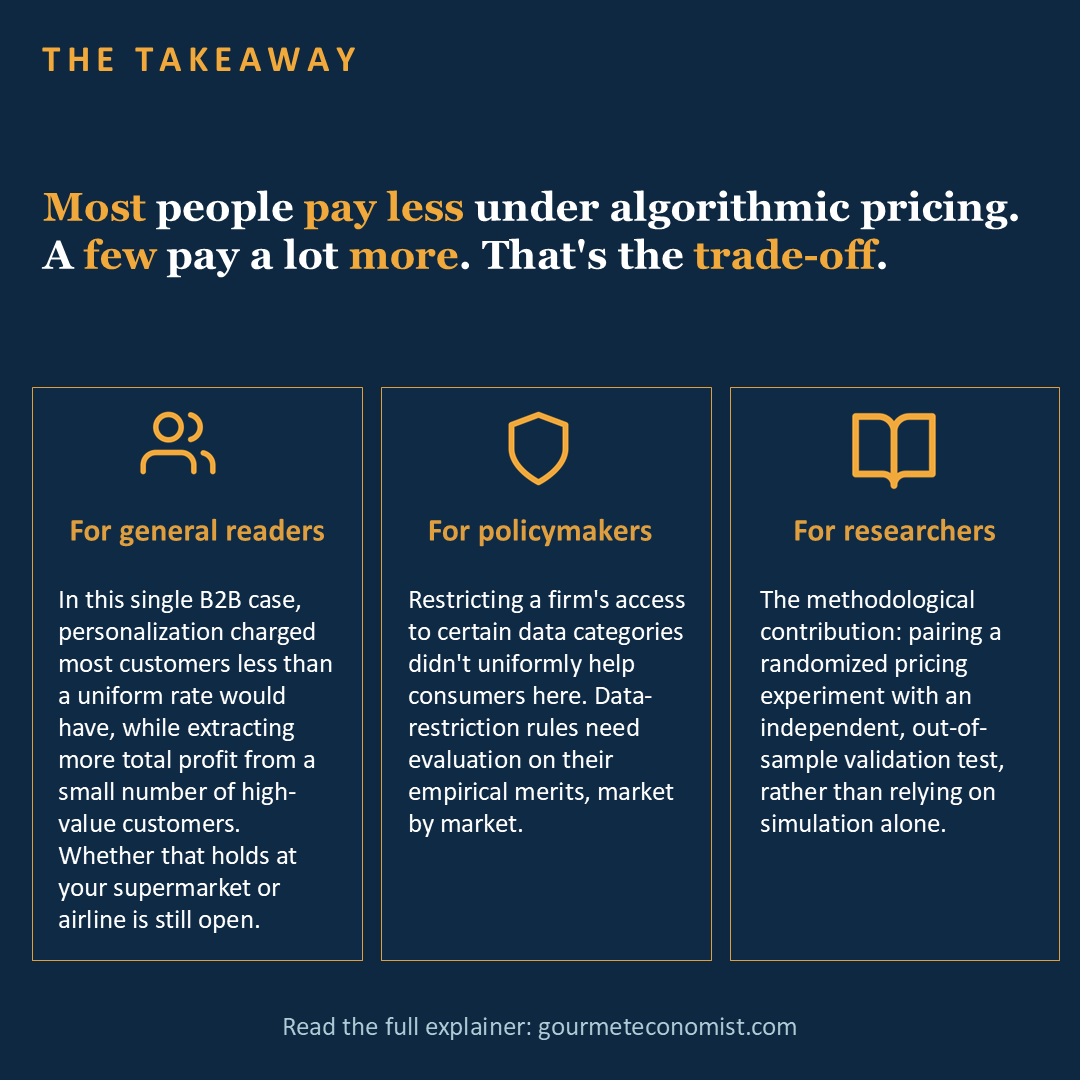
For the general reader, the takeaway is narrower than the headline-grabbing versions that tend to circulate: in this single B2B case study, a personalized pricing algorithm built from voluntarily disclosed business information ended up charging most customers less than a single uniform price would have. At the same time, it extracted more total profit for the firm by charging a small number of high-value customers substantially more. Whether that pattern holds in the markets you actually shop in, like a local supermarket, a digital subscription service, or an airline booking site, remains an open empirical question that this paper does not answer.
For policymakers evaluating data-privacy rules such as Europe’s GDPR or California’s CCPA, the most concrete finding is that restricting a firm’s access to certain categories of customer data did not uniformly benefit consumers. In multiple tested scenarios, data restrictions reduced consumer surplus further than the unrestricted version.
The authors frame this as a reason for caution: data-restriction policies must be evaluated on their actual empirical merits in a given market, rather than simply treating “less data available to firms” as automatically synonymous with “better outcomes for consumers”. The authors do not conclude that personalized pricing is generally welfare-improving; instead, they argue that policies should not assume it is automatically harmful.
For researchers, the paper makes two methodological contributions. First, it estimates the pricing model using one randomized experiment, then tests its predictions in a second, independent field experiment with new customers, rather than relying on simulated outcomes from a single dataset, as was more common in prior work. Second, it uses a statistical resampling technique called the “weighted likelihood bootstrap” to generate a range of plausible values for the model’s estimates, which the authors then use to quantify the uncertainty surrounding their demand estimates and pricing recommendations, without the computational burden of traditional fully Bayesian simulation methods in high-dimensional settings.
The broader contribution of this paper is to convert the common assumption that personalized pricing necessarily harms consumers into a rigorous, empirical question. In this case study, the answer turned out to depend heavily on which specific customers you ask and how you choose to sum their economic outcomes.